
The pantheon everyone quotes is the edited version
Search "Aztec mythology" and what comes back looks like a finished, ancient pantheon: Huitzilopochtli, Quetzalcoatl, Tlaloc, Coatlicue, laid out in tidy encyclopedia entries as if this were simply how the Mexica had always understood their gods. Almost everything modern readers know about it comes from documents written or recopied after the Spanish conquest, above all the Florentine Codex compiled under the Franciscan friar Bernardino de Sahagún in the 1540s to 1570s, a full century after most of the events it describes. That gap alone would make the record incomplete. What makes it something stranger is that there was an earlier, deliberate gap too, one the Mexica state created itself. The neighboring Maya record has a gap of its own: among the Maya gods, one letter still stands in for a name.
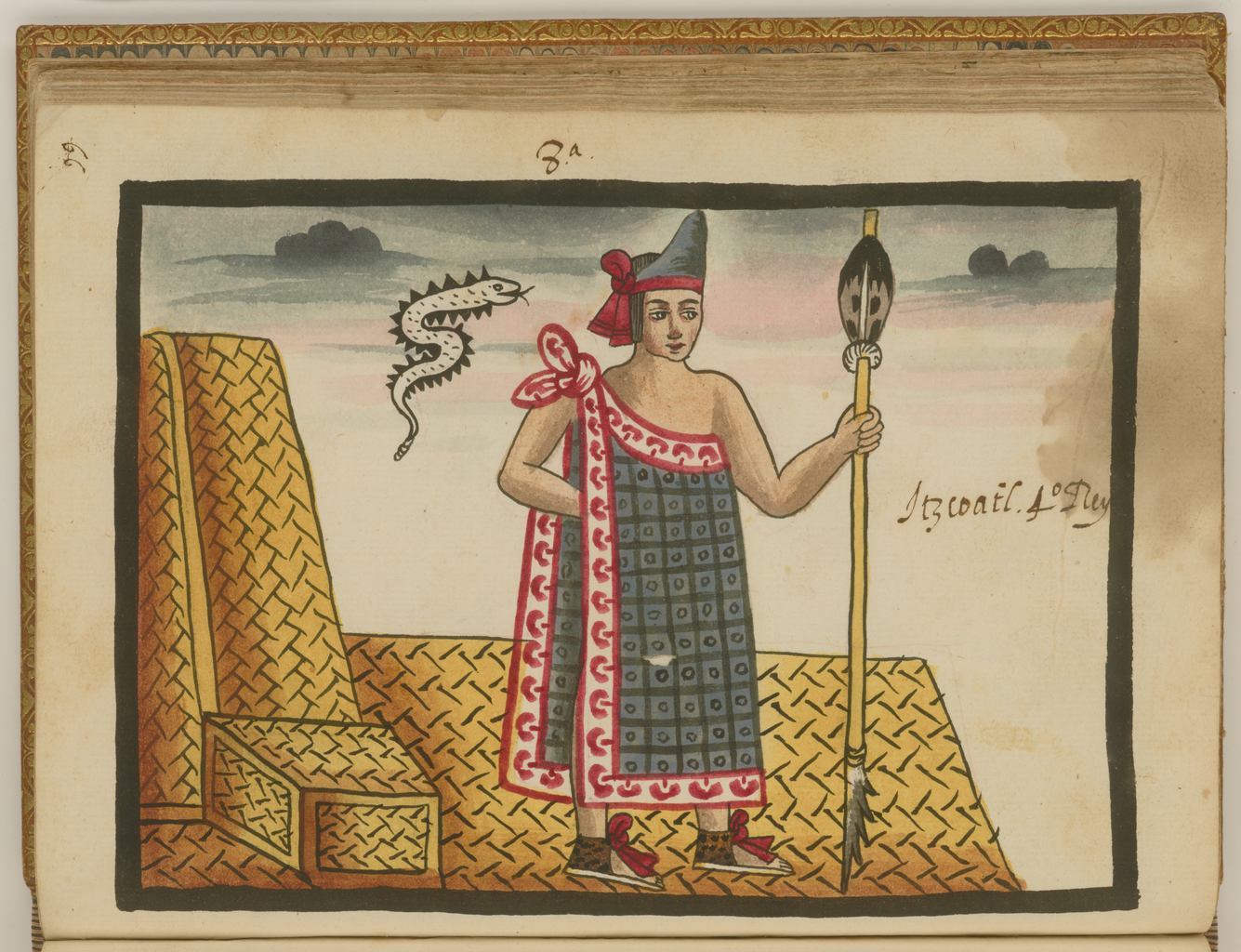
According to the Florentine Codex, Itzcoatl, the fourth ruler of Tenochtitlan, ordered the destruction of the earlier pictorial histories that recorded Mexica history and belief up to that point. The stated justification, in the codex's own words, was that it was "not wise that all the people should know the paintings." Some historians credit the actual policy to Tlacaelel, Itzcoatl's chief adviser and the power behind several Mexica rulers, who is said to have argued for wiping the older record clean so a new, state-approved version of Mexica history and destiny could take its place. Once the paintings were gone, there was no earlier text left to contradict whatever version the state chose to write next.
Rewritten to make one god look permanent
The clearest beneficiary of that rewrite was Huitzilopochtli. Unlike Tlaloc, a rain god worshipped across highland Mexico for centuries before the Mexica ever arrived, or Quetzalcoatl, the feathered serpent the Mexica inherited rather than invented, Huitzilopochtli has no clear equivalent in earlier Mesoamerican religion; he was, by most accounts, a minor patron god specific to the Mexica themselves. Tlacaelel is credited with changing that directly: he is said to have recast the Mexica as a chosen people and, in the same program, elevated Huitzilopochtli to the top of the pantheon, on top of ordering the burning of conquered peoples' historical records to erase memory of a pre-Mexica past. As the Mexica tribe rose from wandering migrants to the dominant power in the Valley of Mexico, Huitzilopochtli's cult rose with them, from a local patron god to, after Tlacaelel's reform, the deity credited with keeping the sun itself alive.
That's a very different picture from "the Aztec pantheon," a phrase that implies a settled cast list handed down unchanged. What survives is closer to a curated one, edited under a ruler whose own chief adviser is credited with wanting the previous draft gone.
Even the current age doesn't have one origin story
The best-known Aztec creation account is the Five Suns: four earlier worlds, each created and then destroyed, with the present age as the fifth. On the broad shape, sources mostly agree. Two of the major colonial-era compilations, the Historia de los mexicanos por sus pinturas and the Leyenda de los Soles (also called the Codex Chimalpopoca), even agree on the same total span of 2,028 years across all five ages. Where they stop agreeing is on the details of who ruled which sun, in what order, and how each one specifically ended, a divergence modern scholarship attributes partly to oral transmission and partly to the same pattern seen with Huitzilopochtli: which god got credit for which era shifted along with that god's political standing at the time a given version was written down.
| Sun | Ruling god | How it ended |
|---|---|---|
| First | Tezcatlipoca | Knocked from the sky by Quetzalcoatl; jaguars devoured the giants who lived there |
| Second | Quetzalcoatl | Hurricane winds swept the world away; survivors became monkeys |
| Third | Tlaloc | A rain of fire, after Tezcatlipoca took his wife Xochiquetzal |
| Fourth | Chalchiuhtlicue | A flood lasting 52 years; survivors became fish |
| Fifth (current) | Nanahuatzin, reborn as Tonatiuh | Still running; predicted to end in earthquake and sky monsters |
In the version told in the Florentine Codex and the Leyenda de los Soles, the gods gather in darkness at Teotihuacan and ask for a volunteer to burn himself alive and become the new sun. A wealthy, healthy god named Tecuciztecatl volunteers first and loses his nerve at the edge of the fire. It's the poor, scarred god Nanahuatzin who walks in without hesitating, becomes the sun, and is only afterward given the name Tonatiuh. Huitzilopochtli doesn't appear in that account at all, which is what makes his standing as "the sun" elsewhere in Aztec religion worth pausing on: Wikipedia's entry on Tlacaelel, drawing on the chronicler Diego Durán, states plainly that Tlacaelel's religious reform is what put Huitzilopochtli into that solar role in the first place, displacing Nanahuatzin. A god who wasn't originally part of the origin story got installed into it after the fact, by the same adviser credited with having the earlier records burned.
When a myth becomes a floor plan
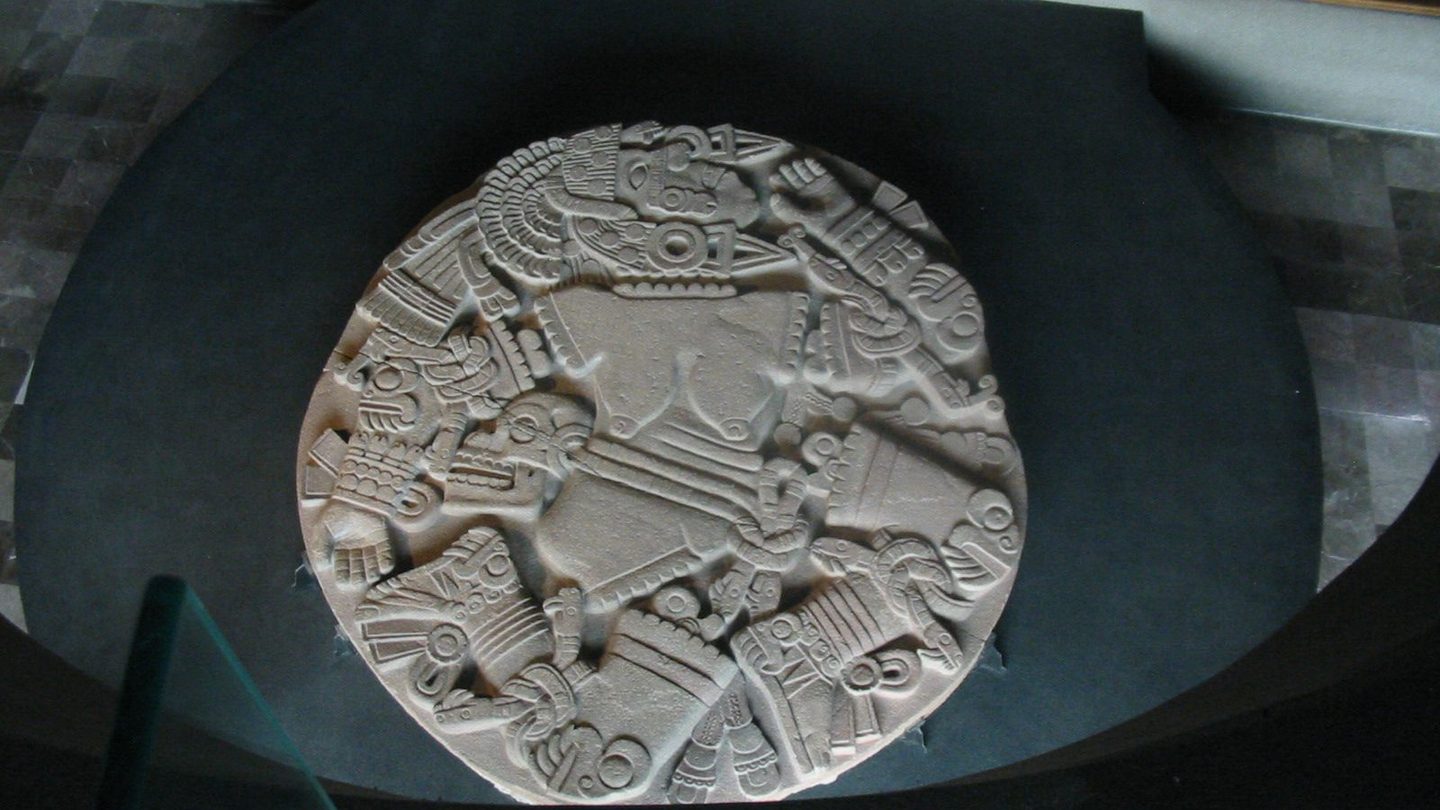
On February 21, 1978, electrical company workers digging in downtown Mexico City struck a massive carved stone, 3.4 meters across, dated to around 1473 during the reign of the Mexica ruler Axayacatl. It showed a goddess, decapitated and dismembered, her limbs scattered around her torso. The find led archaeologist Eduardo Matos Moctezuma to launch a full excavation of the site, which turned out to be the base of the Templo Mayor, the main pyramid of Tenochtitlan.
The carving is Coyolxauhqui, and the myth behind it is Huitzilopochtli's own birth story, the same reform-era myth that put him in the sun's role to begin with. In it, Huitzilopochtli is born fully grown and armed on the mountain Coatepec, at the exact moment his sister Coyolxauhqui leads their other siblings in an attack on their mother, Coatlicue; he kills Coyolxauhqui, cuts off her head, and throws her dismembered body down the mountainside. Aztec religion read this as a daily event, not a one-time origin: Huitzilopochtli as the sun, endlessly fighting off his sister the moon and his brothers the stars to rise again each morning. The stone wasn't placed at the Templo Mayor as a decoration for that story. Archaeologists found it set at the exact foot of the staircase leading up the temple's Huitzilopochtli side, the side where sacrificed captives' bodies were thrown down the steps after the ritual on the summit was finished, landing on the same carved image of Coyolxauhqui below. A myth about a god still fighting his sister every single day was carved permanently into the one staircase where that fight got restaged in front of a crowd.
_WDL6721.png)
The gods the rewrite didn't touch
Not every figure in this pantheon needed Itzcoatl's help. Tlaloc and Quetzalcoatl both predate the Mexica by centuries, worshipped across the Valley of Mexico under earlier civilizations before the Mexica ever settled Tenochtitlan in 1325; their myths survived the 1430s rewrite because they were already too widely established across rival city-states to erase or replace. Huitzilopochtli's story is the one that had to be built, retroactively, into something that could stand next to them. It's a narrower version of a pattern ancient Egypt handled completely differently: three separate creator gods with three rival origin stories, left to coexist for three thousand years without anyone burning the losing accounts. The Mexica chose consolidation instead of coexistence, and consolidation needed the earlier paper trail gone first.