
What the symbol actually stood for
The word wedjat, the term ancient Egyptians used for the symbol now popularly called the Eye of Horus, means roughly "the whole one" or "the sound one," describing a wound made complete again rather than the eye that started it. According to the Eye of Horus entry on Wikipedia, the symbol represented well-being, healing, and protection, and it carried enough weight that Egyptians of both the living and the dead wore it: pendants and rings for the living, and amulets tucked into mummy wrappings for burial, worked in gold, silver, lapis lazuli, and the blue-glazed ceramic called faience.
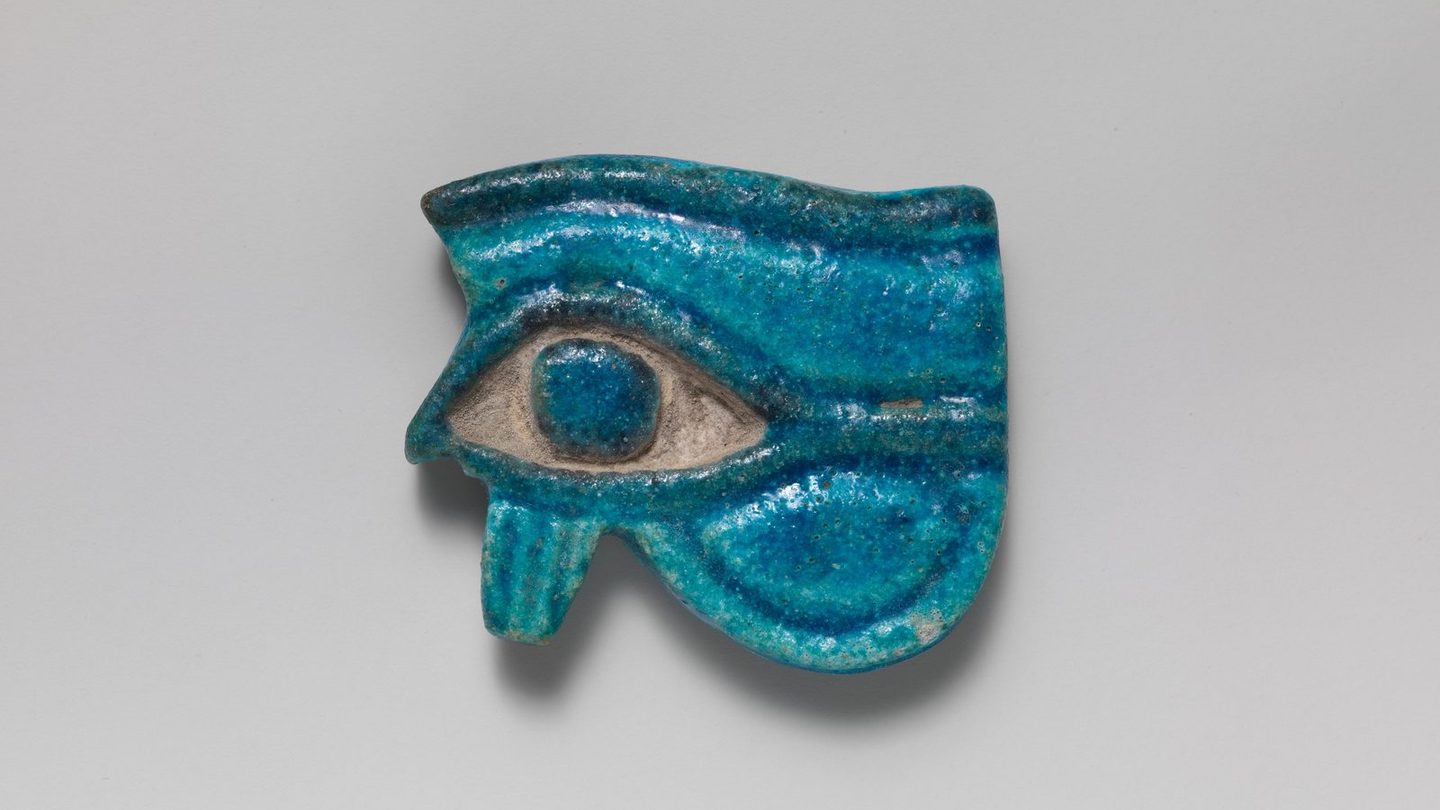
That range of materials is easy to verify in surviving museum collections, not just in written descriptions. A faience wedjat amulet from around 1090-900 BC, now in the Metropolitan Museum of Art's collection, is a plain, mass-producible version of the symbol, exactly the kind of object an ordinary Egyptian, not only royalty, could afford to be buried with or wear day to day.
The myth: Set tears it out, Thoth puts it back together
The wedjat's meaning traces to a specific episode in the succession dispute that followed Osiris's death. Horus, Osiris's son, and Set, his rival, contest who should inherit the throne of Egypt, and the fight turns physical: in the best-known version, Set tears out or destroys one of Horus's eyes during the struggle. The eye is not simply regrown. It has to be actively restored, most often credited to Thoth, the god associated with writing and the moon, though a small number of versions instead credit Hathor or Isis with the healing. Once whole again, Horus offers the restored eye to his dead father, and its revitalizing power is said to sustain Osiris in the afterlife, linking the symbol to resurrection as directly as it is linked to Horus's claim to the throne.
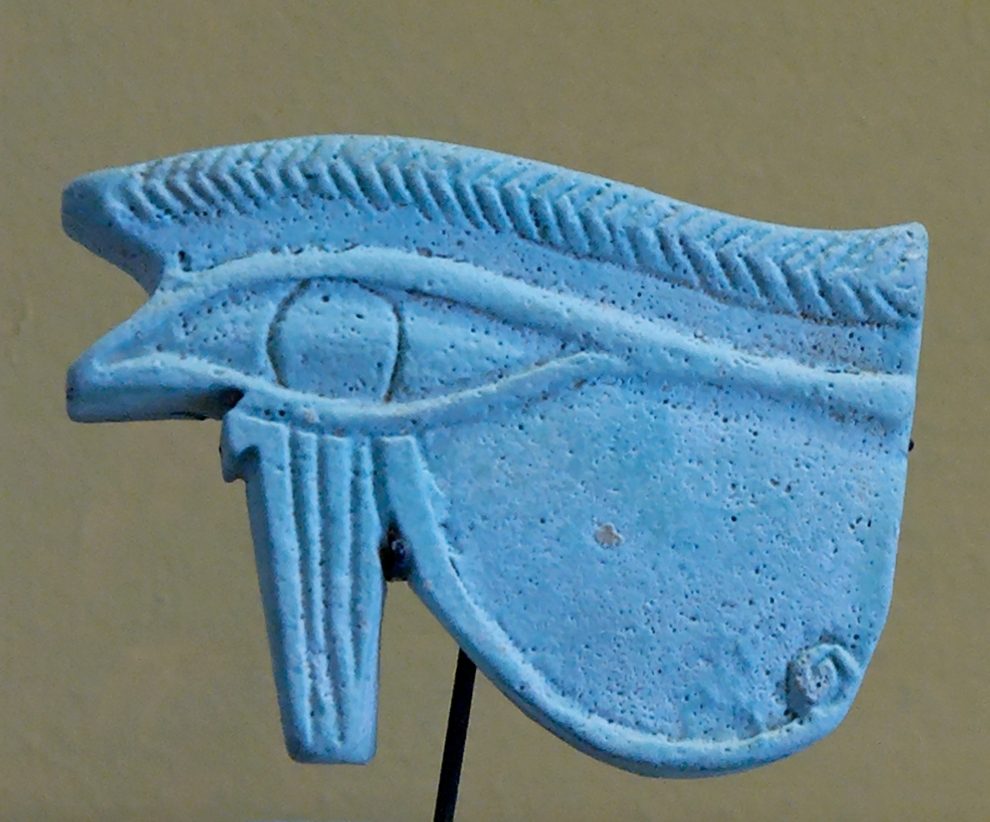
This is not a late or minor story. References to Set stealing and Horus reclaiming the eye already appear in the Pyramid Texts, inscribed inside royal pyramids during the Old Kingdom, roughly 2686 to 2181 BC, making the conflict one of the oldest attested episodes in Egyptian religious literature. The amulet form of the symbol traveled with Egyptian trade and cultural influence well beyond Egypt's own borders and well past the era usually associated with pharaonic Egypt: a faience wedjat amulet excavated at the Achaemenid palace site of Susa, in present-day Iran, and dated to the late 6th through 4th centuries BC, shows the same protective symbol still in circulation well over a millennium after the Old Kingdom, carried east through Persian-controlled Egypt.

Six fractions that summed to 63/64, not 1
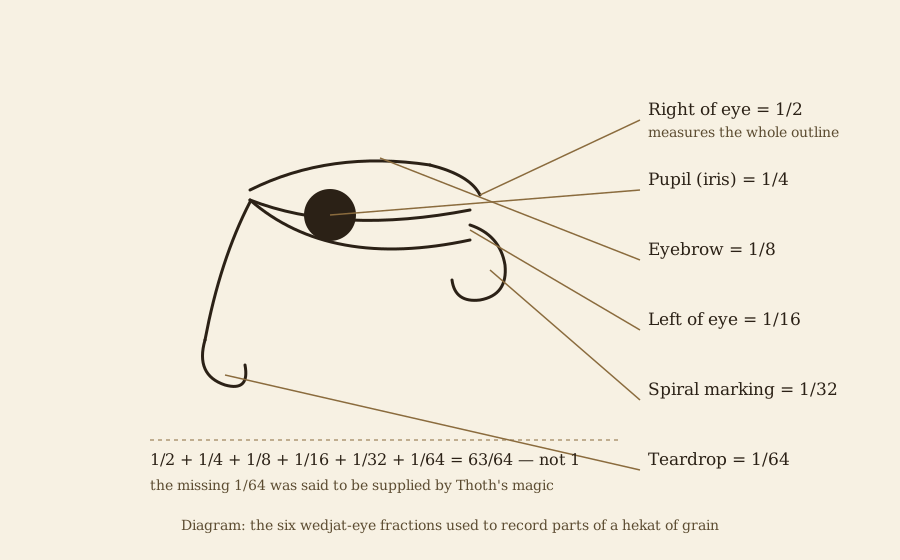
Past the mythology, the wedjat glyph had a second, entirely practical life as a piece of measuring notation. Egyptologists and mathematicians reading the standard element-by-element breakdown of the symbol have matched each of its six component strokes to a unit fraction, all with denominators that are powers of two: the right side of the eye to 1/2, the pupil to 1/4, the eyebrow to 1/8, the left side of the eye to 1/16, the curved marking below the eye to 1/32, and the teardrop marking to 1/64, according to the Eye of Horus Fraction entry on Wolfram MathWorld. Scribes used these six symbols to record fractions of a hekat, the standard ancient Egyptian volume unit for measuring grain, bread, and beer, equal to roughly 4.8 liters, per Wikipedia's entry on the hekat.
Add the six fractions together and they come to 63/64, not a full 1, a shortfall ancient tradition explained mythically rather than mathematically: the missing 1/64 was said to be supplied by Thoth's magic, completing what the fractions alone could not, the same god who restores the eye itself in the myth doing double duty as the fix for its arithmetic. That smallest fraction, 1/64 of a hekat, corresponded to a real named subunit called the dja, and Egyptian medical texts subdivided further still, down to the ro, roughly a spoonful and equal to 1/320 of a hekat, for measuring out prescription ingredients. The wedjat's fractions were not a decorative flourish borrowed from the myth; they were the working notation a scribe or physician actually wrote down.
A 2019 medical hypothesis, not an ancient one
Search for an explanation of why the Eye of Horus has six parts and a large share of what comes back is a claim that each fraction also stands for one of the six human senses, smell, sight, thought, hearing, taste, and touch. That pairing shows up across jewelry listings and pop-symbolism blogs, almost always stated flatly and without a citation to any ancient Egyptian source, because there isn't one. No Pyramid Text, Coffin Text, or surviving mathematical papyrus assigns senses to the wedjat's fractions; their only well-documented ancient use was arithmetic, measuring grain, medicine, and other capacities.
The senses claim appears to trace to something else entirely: a 2019 paper in the peer-reviewed medical journal Cureus, titled "The Eye of Horus: The Connection Between Art, Medicine, and Mythology in Ancient Egypt," by Karim ReFaey, Gabriella C. Quinones, and colleagues including the neurosurgeon Alfredo Quiñones-Hinojosa. The authors superimpose the six-part wedjat symbol onto a sagittal image of the human brain and propose that each part's position roughly corresponds to the anatomical location of a particular sense, framing it as a speculative modern observation about the ancient Egyptians' possible anatomical insight, not a claim that Egyptian scribes themselves intended any such mapping. Treating a 2019 neurosurgery journal's speculative overlay as a documented fact of Old Kingdom belief inverts the actual chain of evidence.
Eye of Horus vs. Eye of Ra
The two eyes share a glyph but not a myth. Ra's eye is the one that turns violent in the Book of the Heavenly Cow, transforming into the lioness Sekhmet and coming close to wiping out humanity before Ra tricks her into standing down. Horus's eye belongs to an entirely separate storyline, the succession fight with Set, and it is Horus's version specifically, not Ra's, that mathematicians and Egyptologists catalogue as the source of the six-part fraction system described above: every reference to the "Eye of Horus fraction" in the math-history literature points to this myth's eye, even though the wedjat glyph used to write it looks identical to the one attached to Ra.
Read the fuller Eye of Ra story for how that separate myth plays out, including the detail that the same glyph could be relabeled Ra's, Horus's, or occasionally Osiris's depending on which temple was telling it, a fluidity in naming that never carried over to which myth the fraction system got credited to.
Amulets then and now
Ancient Egyptians treated the wedjat as protection for both the living and the dead, worn as jewelry in daily life and placed directly among mummy wrappings, alongside other funerary amulets tied to Anubis's role guiding souls through burial and the afterlife, to protect the body on its journey. According to the Eye of Horus entry on Wikipedia, sailors painted the symbol on ships for safe passage, extending its protective claim beyond the human body to the vessel carrying it. The same glyph sits within the broader Egyptian pantheon's shared visual language of protective symbols, one of several the culture relied on, not a singular outlier.
That continuity is part of why the symbol still circulates today, largely stripped of its original arithmetic function: contemporary jewelry markets it as a general protection charm, a much narrower reading than the ancient Egyptians' own use of the same six-part glyph as protection, healing, kingship marker, and working measuring notation all at once.