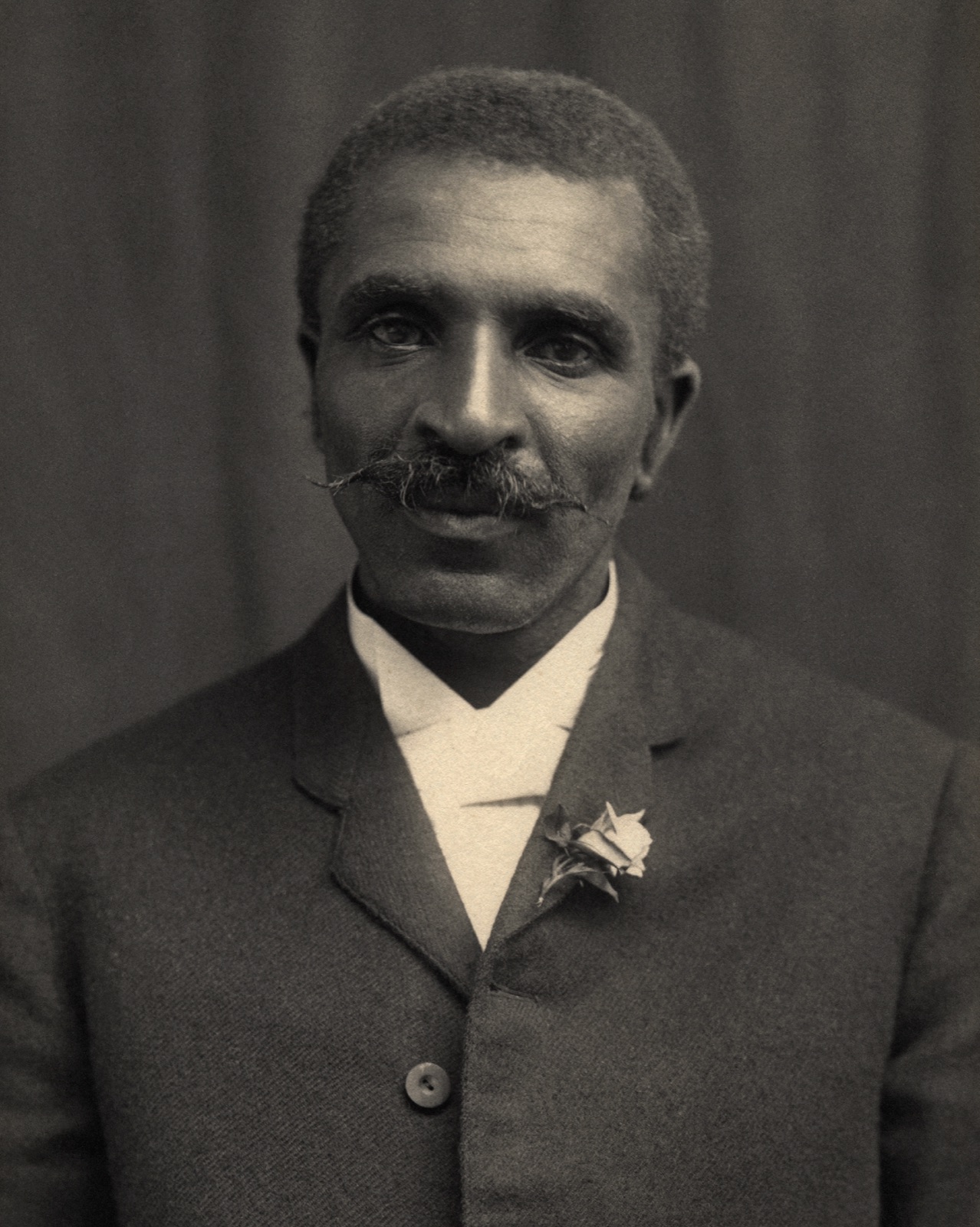

The claim everyone learned in school
Ask most Americans what George Washington Carver did, and you'll get one answer: he invented peanut butter. It's in textbooks, trivia games, and Black History Month bulletin boards every February. It's also not true, and it hasn't been true for as long as anyone has been saying it.
Peanuts ground into a spreadable paste are much older than Carver, older than the United States. The Aztecs and Incas were mashing roasted peanuts into paste centuries before European contact with the Americas. The modern, patented version of peanut butter also predates Carver's public career by a wide margin. In 1884, a Montreal pharmacist named Marcellus Gilmore Edson patented a process for milling roasted peanuts between heated surfaces until they reached what his patent called a "fluid or semi-fluid state." Carver was in his early twenties at the time, working toward a high school diploma in Kansas. He would not enroll at Iowa State Agricultural College for several more years and would not join Tuskegee Institute until 1896.
A decade after Edson's patent, Dr. John Harvey Kellogg (yes, that Kellogg, of cereal fame) filed for his own peanut butter patent in 1895, granted in 1897 for a process of boiling raw peanuts for hours before rolling them into paste as a soft protein source for patients at his Michigan sanitarium. St. Louis food entrepreneur George A. Bayle was selling a version closer to what ends up on supermarket shelves today around the same period, and by the 1904 World's Fair in St. Louis a farmer named C.H. Sumner was selling peanut butter from a concession stand there, taking in a little over $700, at a time when Carver was still an early-career professor at Tuskegee with no public profile to speak of. The fair gets credited in a lot of retellings as peanut butter's "debut," but food historians have found no primary evidence that anyone in St. Louis actually introduced or popularized it; the spread had already been sold commercially for roughly a decade by then. By 1919, American factories were turning out roughly 158 million pounds of peanut butter a year. None of it involved Carver.
So how did the myth start?
If Carver didn't invent peanut butter, why does practically everyone think he did? The honest answer is that no single source pins down the exact moment the myth took hold, but the documented pieces line up into a plausible picture.
Carver became the peanut industry's most visible public advocate at exactly the moment peanut butter was becoming a mainstream American food. In 1916 he published a bulletin titled "How to Grow the Peanut and 105 Ways of Preparing It for Human Consumption," and in 1921 he testified before Congress on behalf of peanut growers seeking tariff protection, a performance that made him a minor national celebrity. He was already being mythologized while he was alive; a 1921 Success Magazine profile called him the "Columbus of the Soil." Once a public figure is that closely identified with a crop, it takes surprisingly little for popular memory to compress "promoted peanuts constantly and found hundreds of uses for them" into "invented the most famous peanut product there is."
Carver didn't help his own historical record much, either. He filed for only a handful of patents in his life and was notoriously reluctant to document his research in the kind of detail that would let later historians trace exactly what he did and didn't originate. That gap made it easier for a tidy, wrong story to fill the space where a messier, true one belonged.
What Carver actually did, and why it mattered more
Strip away the peanut butter myth and the real story underneath is, if anything, a better one. Carver was born into slavery in Diamond Grove, Missouri, sometime in the early-to-mid 1860s. Historians don't actually know the exact year: estimates range from about 1860 to 1865, and the National Park Service lists his birthday as July 12, 1864, while other sources place it closer to 1865, after Missouri abolished slavery. Carver himself said he wasn't sure. That gap exists because the births of enslaved people in Missouri were rarely recorded at all, so there was never a document for anyone to check against.
Carver left home around age eleven or thirteen (accounts vary) to chase an education that was almost never available to Black children in rural Missouri. He homesteaded briefly in Kansas, studied art at Simpson College, then transferred to Iowa State Agricultural College, where he became the school's first Black student and eventually earned a master's degree in 1896. Booker T. Washington, founder of Tuskegee Institute in Alabama, recruited him that same year specifically because Carver was, at the time, the only African American in the country with an advanced degree in scientific agriculture. Carver stayed at Tuskegee for the rest of his life, 47 years, running its agriculture department and directing its experiment station.
The actual problem Carver spent his career solving was soil, not spreads. Decades of growing nothing but cotton had stripped nutrients out of Southern farmland, and when the boll weevil began devastating cotton crops starting in the early 1890s, many already-poor farmers, a large share of them formerly enslaved people or their children, had no fallback. Carver pushed crop rotation as the fix: plant nitrogen-depleting cotton one year, then nitrogen-restoring legumes like peanuts, or sweet potatoes, the next, letting the soil recover while still producing something sellable. To make that rotation worth a farmer's while, he then went looking for markets and uses for the alternative crops, since a farmer can't rotate into a crop nobody will buy. Over the following decades he developed a genuinely large number of practical and industrial applications for peanuts (dyes, cooking oils, wood stains, cosmetics), sweet potatoes, and soybeans; different institutional sources cite different exact tallies, but the U.S. Department of Agriculture and Tuskegee itself both describe roughly 300 peanut-derived products alone, alongside well over 100 uses each for sweet potatoes and soybeans.
He didn't stop at research papers. In 1906 he built the Jesup Wagon, a horse-drawn mobile classroom stocked with plows, seed samples, a cream separator, and demonstration charts, so he could bring crop-rotation instruction directly to farmers who had no way to travel to Tuskegee and, in many cases, couldn't read the printed bulletins. It became the model for Tuskegee's "Movable School" extension program, which kept operating in various forms into the 1940s. That combination, real soil science plus a genuine effort to get it into the hands of the farmers who needed it most, is a harder and more durable achievement than inventing a sandwich spread.
Why the real story is worth knowing
The peanut butter myth is a downgrade dressed up as a compliment. It replaces a scientist who helped rebuild the economic footing of the rural South after slavery with a cartoon of a man in a lab coat who stumbled onto a sandwich condiment. Carver's actual work sat at the intersection of agronomy, economics, and racial justice: he was giving formerly enslaved farmers and their descendants a way to escape a system, cotton monoculture and sharecropping debt, that was designed to keep them poor. That story doesn't fit neatly on a trivia card, so the simpler, wrong one won out instead.
None of this erases peanut butter from Carver's legacy entirely. His 1916 bulletin did include recipes and preparation methods that touched on peanut pastes, and he was undeniably the person who did more than anyone else to make peanuts a mainstream American crop worth building a product around. He just wasn't first, and he never claimed to be. The myth was built after the fact, by admirers filling in a gap Carver's own reluctance to self-document left wide open. It's a familiar pattern in how history gets simplified: even a disputed ancient landmark like the Hanging Gardens of Babylon shows the same dynamic, where the version everyone repeats turns out to rest on shakier ground than the messier, real one. MythCairn's Invented History hub covers a handful of other credited-wrong stories, including who actually invented electricity and the telephone.