
A question the Iliad won't settle
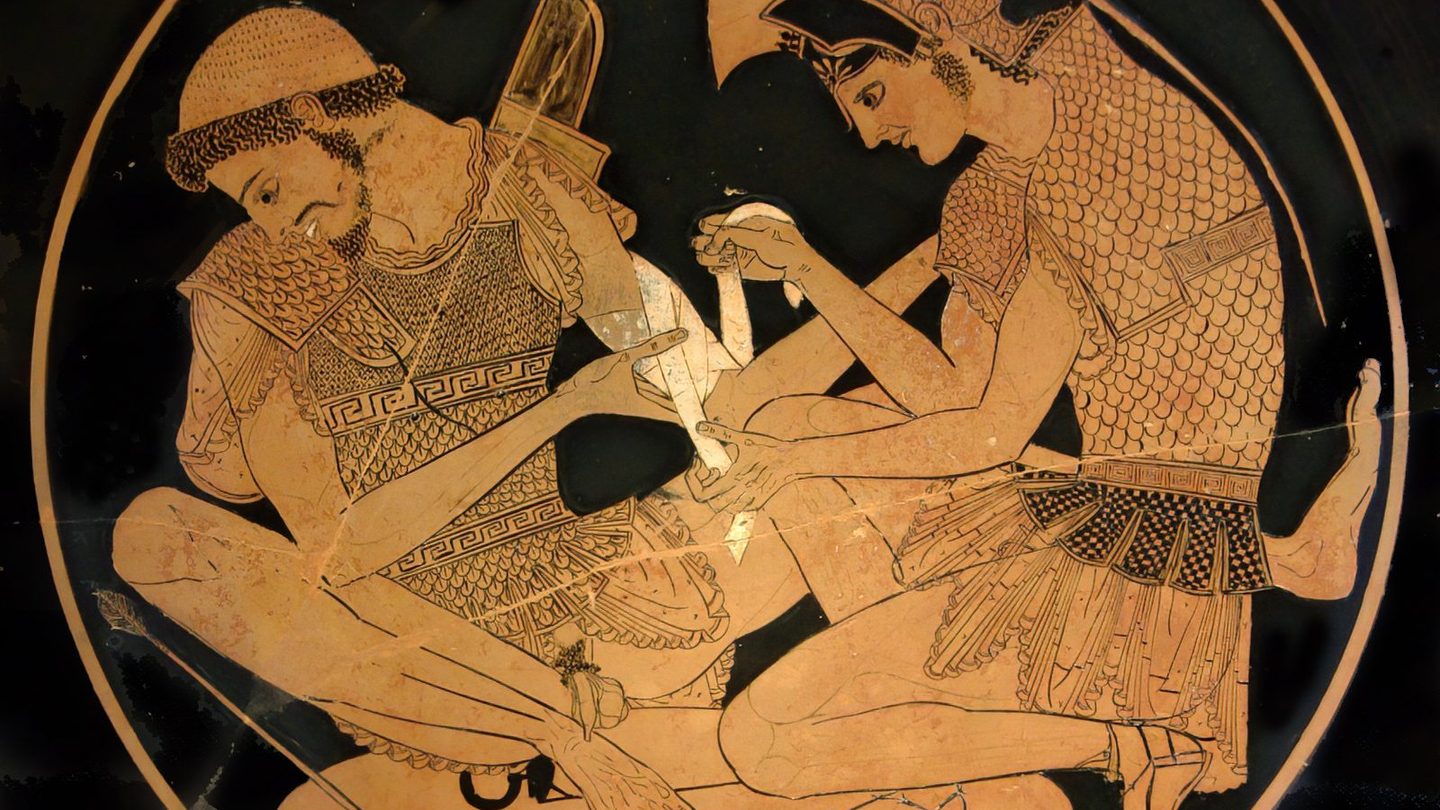
Achilles is the Iliad's greatest fighter, son of the mortal king Peleus and the sea nymph Thetis, a lineage traced in full on the wider Greek pantheon's family tree. Patroclus is the man he is closest to, present at his side through most of the poem and the reason Achilles finally returns to battle after sitting out the war in a rage at Agamemnon. When Patroclus dies partway through the epic, Achilles's grief drives the rest of the story: the killing of Hector, the funeral games, the ransom of Hector's body. Homer spends more lines on this relationship than on any other bond in the poem apart from Achilles's dispute with Agamemnon.
What Homer does not do is say plainly what kind of relationship it was. He gives Achilles and Patroclus real tenderness, real grief, and a wish, voiced by Patroclus's ghost, to have their bones buried together. He never gives them a scene that settles whether that tenderness was romantic. Readers as early as the 5th century BC filled in the gap themselves, and disagreed about how to fill it almost as soon as they started. The dispute below dates to Homer's earliest readers, making it one of the oldest continuous arguments in the history of reading the poem.
Cousins, but the family tree is disputed
Before the argument about lovers, there is a smaller, less-discussed one about family. According to the fuller genealogical tradition, Patroclus's father Menoetius was a son of Actor and the nymph Aegina. Zeus had earlier fathered Aeacus on that same Aegina, and Aeacus's son Peleus became Achilles's father. That makes Achilles and Patroclus first cousins once removed, sharing a common ancestor two generations back on Patroclus's side (Aegina is his grandmother through Menoetius) and three on Achilles's (Aegina is his great-grandmother through Peleus and Aeacus). A separate, more obscure tradition, attributed to Hesiod, skips the extra generation and makes Menoetius a full brother of Peleus, which would make the two heroes plain first cousins instead. The two versions do not agree with each other, and neither Homer nor most ancient sources dwell on the kinship at all. It shows up in the background of the genealogies and almost never in the story itself, which treats their bond as a matter of choice and long companionship rather than blood.
The Iliad does give one specific, datable detail about their ages, and it becomes important later. In Book 11, Nestor reminds Patroclus of instructions his father Menoetius gave him years earlier, on the day Peleus sent him off to war alongside Achilles: "My child, in birth is Achilles nobler than thou, but thou art the elder though in might he is the better far" (Iliad 11.786-789, A.T. Murray's translation). Homer is explicit here that Patroclus is the older of the two, even though Achilles outranks him by birth and outmatches him in combat. That single line, said almost in passing, is the piece of evidence later Greek writers would return to when they tried to work out which of the two men was supposed to have been the lover and which the beloved, in a culture where those roles were not interchangeable.
What actually happens between them in the poem
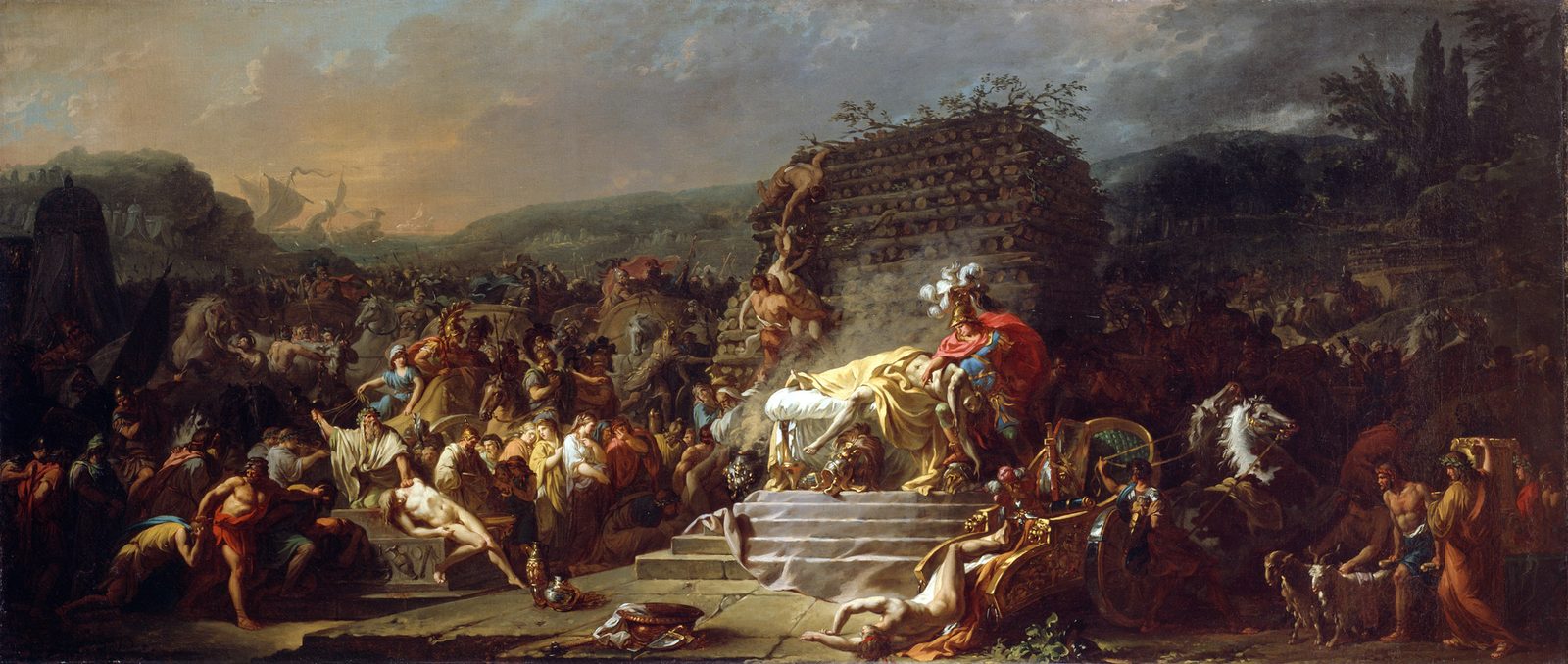
The event that matters most between them in the Iliad is a death, not a declaration. Patroclus talks Achilles into lending him his armor and leading the Myrmidons back into battle, and dies at Hector's hands while still wearing it. Achilles's reaction, when the news reaches him in Book 18, is physical and extreme: "a black cloud of grief enwrapped Achilles, and with both his hands he took the dark dust and strewed it over his head and defiled his fair face, and on his fragrant tunic the black ashes fell. And himself in the dust lay outstretched" (Iliad 18.22-27, A.T. Murray's translation). Thetis hears her son's cries from beneath the sea before she even learns why. Achilles refuses to eat, has new armor forged for him by Hephaestus at his mother's request, and returns to the war specifically to kill Hector, fully aware, because Thetis has already told him, that his own death will follow soon after.
The classicist Gregory Nagy, writing for Harvard's Center for Hellenic Studies, points to a specific word Homer uses for Patroclus, therapon, as a clue to how deep this bond runs structurally in the poem. Therapon traces back to a borrowed Hittite term, tarpanalli-, meaning something closer to "ritual substitute" than a simple "companion" or "attendant." In that reading, Patroclus functions in the story as Achilles's other self, someone whose death stands in for a death Achilles is fated to suffer himself, which is part of why the poem treats his loss as inseparable from Achilles's own mortality rather than as an ordinary battlefield casualty.
The clearest statement of what Patroclus wants from Achilles comes after his own death, when his ghost visits Achilles in a dream in Book 23 and asks for one specific thing regarding their burial: "Lay not my bones apart from thine, Achilles, but let them lie together... even so let one coffer enfold our bones, a golden coffer with handles twain, the which thy queenly mother gave thee" (Iliad 23.65-92, A.T. Murray's translation). Achilles agrees without hesitation. Of everything either man says to the other across the whole epic, it is the plainest, most direct favor asked, and it concerns only how their remains should rest afterward, not anything that passed between them while both were alive.

The Greeks who came after Homer thought they knew the answer
Homer's silence did not last. By the 5th century BC, the playwright Aeschylus had written a tragedy called Myrmidons, now lost except for fragments, in which Achilles openly mourns Patroclus as a lover. One surviving fragment has Achilles speak over Patroclus's corpse: "No reverence hadst thou for the unsullied holiness of thy limbs, oh thou most ungrateful for my many kisses!" (Aeschylus, Myrmidons, H. Weir Smyth's translation). The reference to reverence for the limbs echoes the formal language ancient Greek supplication rituals used, so the line is not unambiguously sexual on its face. Its plain force, an accusation of ingratitude for physical intimacy, is what later readers picked up on and ran with regardless.
Plato pushed back on Aeschylus directly, and did so using the age detail from Nestor's speech in Book 11. In the Symposium, written decades after Aeschylus, the character Phaedrus argues: "Aeschylus talks nonsense when he says that it was Achilles who was in love with Patroclus; for he excelled in beauty not Patroclus alone but assuredly all the other heroes, being still beardless and, moreover, much the younger, by Homer's account" (Plato, Symposium 180a). Phaedrus is not disputing that the two were lovers. He is disputing the roles Aeschylus assigned them. In Athenian convention, the older partner in a same-sex relationship between men was expected to be the pursuer, not the pursued, and Phaedrus's whole argument rests on treating Homer's line about Patroclus being the elder as settled fact, even while treating the romantic reading itself as something everyone already assumed. Two of the most influential writers in Greek literature read the same eight-century-old poem and arrived at opposite conclusions about who loved whom, using the same handful of lines as their evidence.
Two thousand years of the same argument
The debate never really closed. Roman-era writers, medieval commentators, and 19th- and 20th-century classicists all took positions on it, usually reading their own era's assumptions about male friendship or romance back into the Iliad's silence. What changed in the 21st century was the audience. Madeline Miller's 2011 novel The Song of Achilles retells the Iliad from Patroclus's point of view and depicts the relationship as unambiguously romantic; it won the Orange Prize for Fiction in 2012, the award's final year under that name, and introduced the argument to a much wider readership than academic classics had ever reached.
None of this settles the underlying question, because Homer never gave later readers the evidence to settle it. What the record actually shows is a chain of informed, often contradictory guesses stretching from Aeschylus's Athens to a 21st-century bestseller list, each one confident it had recovered what the epic meant to leave open. The one thing every version agrees on, ancient tragedy, Plato's dialogue, and modern novel alike, is that whatever existed between Achilles and Patroclus was the single most consequential relationship in the story of the Trojan War. Homer leaves an equally large gap at the other end of Achilles's story: the Iliad ends before he dies, and how he actually died turns out to rest on a translation mix-up between two different ankle and heel bones that's been repeated for centuries.