
A messenger with the job built into her name
According to Hesiod's Theogony, composed in the 8th or 7th century BC, Iris is the daughter of the sea-god Thaumas and the Oceanid Electra: "Thaumas wedded Electra the daughter of deep-flowing Ocean, and she bare him swift Iris and the long-haired Harpies, Aello and Ocypetes," in the Evelyn-White translation. That makes the Harpies her full sisters, not distant monsters from an unrelated branch of the family tree, a detail most modern summaries of Greek genealogy skip past entirely.
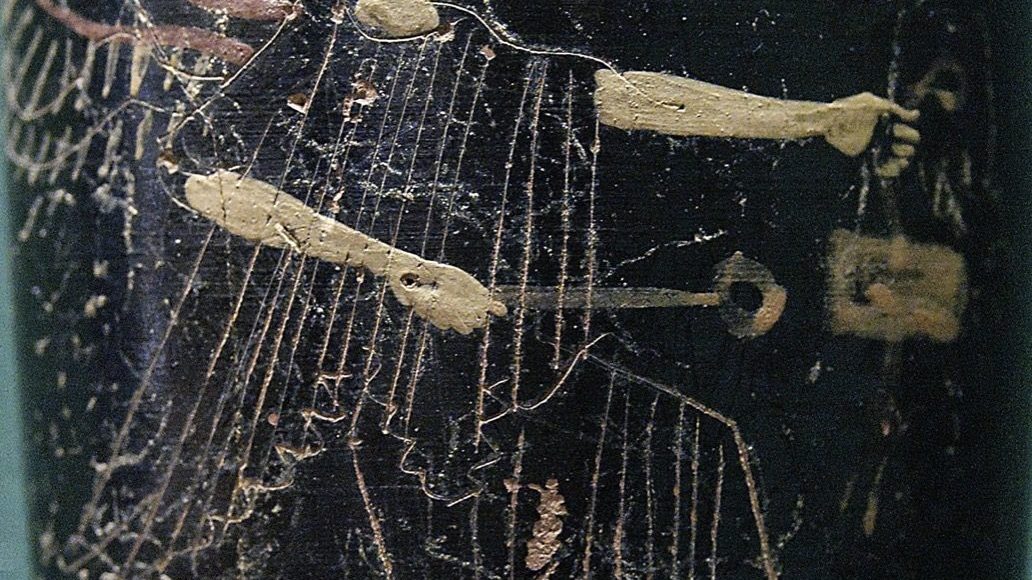
Ancient writers argued over what her name actually meant. Plato, in the Cratylus, proposed that Iris was named from eirein, "to speak," because she was a messenger, though later scholars treat this as one of Plato's playful invented etymologies rather than real linguistics. The explanation now generally accepted traces the name to a Proto-Indo-European root meaning "to bend or turn," describing the rainbow's arc, not her job. In Greek vase painting she appears as a winged young woman carrying a herald's staff, sometimes with a water pitcher in her other hand, an attribute close enough to Hebe's that ancient art historians say the two goddesses are often impossible to tell apart on unlabeled pottery.
Every message in the Iliad, and none in the Odyssey
Iris's workload in the Iliad is heavy and varied. She carries orders mostly for Zeus, occasionally for Hera, and on one occasion for Achilles, when he asks her to summon the winds to light his friend Patroclus's funeral pyre. She does not always wait to be dispatched. Ancient commentary on the poem notes several passages where she advises or intervenes on her own initiative rather than relaying someone else's words.
One of her most fully staged scenes comes in Iliad Book 15, when Zeus sends her to order Poseidon off the battlefield at Troy, and Iris is the one who stays to hear his angry, only-half-compliant reply and press him until he backs down. In Book 24, sent to fetch Thetis from the bottom of the sea, Homer gives her entrance its own small, violent set piece: "Iris storm-footed sprang away... and at a point between Samos and Imbros of the high cliffs plunged in the dark water, and the sea crashed moaning about her. She plummeted to the sea floor like a lead weight," in Richmond Lattimore's translation.
None of that carries over into the Odyssey. Ancient and modern commentators agree on the same plain fact: Iris is not named a single time in the poem. Hermes takes over the messenger role completely, delivering Zeus's order to Calypso in Book 5 in a scene that, a generation earlier in the story's internal chronology, would likely have gone to Iris instead. Later Greek and Roman poets kept using her, but increasingly in Hera's service alone rather than as a general-purpose herald for the whole Olympian household. Her name isn't entirely absent from the poem, though: Book 18 introduces a beggar the suitors nicknamed Irus, the masculine form of Iris, mocking him for running their errands the way the goddess ran Zeus's. It's a joke that only lands because the real Iris never shows up to answer it.
Philosophers decided she was just clouds
Before doctors got hold of her name, philosophers took a swing at her first. As Greek thought shifted from myth toward naturalistic explanation in the 6th and 5th centuries BC, a run of Presocratic thinkers picked the rainbow apart as a natural phenomenon, not a goddess. Xenophanes of Colophon, mocking the anthropomorphic gods of Homer and Hesiod, wrote: "She whom they call Iris, this too is in reality cloud, purple and scarlet and green to the view." Anaxagoras went further, describing the rainbow in almost optical terms: "What we call Iris is the reflection in clouds back toward the sun."
That transition, from goddess to weather to something worth explaining with observation, is documented in detail by Sergio Barbero, a physicist at Spain's Institute of Optics, in a 2023 paper on the word's etymology for the Asian Journal of Physics. Barbero traces the same word through three completely different registers of Greek thought: Homeric religion, Presocratic natural philosophy, and, later still, medicine.
A physician wrote her name into your eye
The medical borrowing came from a specific, datable source. Rufus of Ephesus, a physician working around the 1st or 2nd century AD, compiled the Onomastikon, the earliest known anatomical dictionary, to give students standardized terms for the parts of the body. In it, he wrote: "The iris is that which extends from the pupil to the white of the eye. They say that the color of the iris is black, tawny, blueish-green, or bluish gray." Barbero's paper argues this is, as far as surviving texts show, the first recorded use of the word for that part of the eye, building on earlier anatomical work by Herophilus of Alexandria, who had described the same structure using different Greek terms without settling on "iris" for it.
Even the ancient world wanted to know why that particular word got picked. The physician Galen, writing decades after Rufus, offered his own explanation for the name: dissecting the eye carefully, he claimed, reveals seven layered coats "differing in thickness and color, so that even if you wished you could not give the place any name other than iris," a nod to the rainbow's traditional seven bands. Whether Galen's anatomy was accurate is a separate question from whether his etymology was, and Barbero treats it as plausibly an invented explanation after the fact, in the same tradition as Plato's. The goddess's name reached one more unrelated place worth noting: English adopted "iris" for the flowering plant Iris germanica in the late 14th century, decades before it borrowed the same word for the eye in the early 15th, according to the Online Etymology Dictionary.
A goddess with barely any myths of her own
Outside of her errands, ancient sources give Iris almost nothing to do. The Theoi Project's summary of the classical sources is blunt about it: she has no distinctive mythology of her own, appearing only as a messenger. Earlier poets, including Theocritus and Virgil, describe her as a virgin goddess. Later writers complicate that: a fragment of the lyric poet Alcaeus, preserved by Plutarch in his Dialogue on Love, makes her the wife of the wind-god Zephyrus and mother of Eros, naming him "the most grim of gods, whom Iris of the fair sandals bore, having lain with golden-haired Zephyros." Centuries later, the Byzantine scholar Eustathius and the poet Nonnus instead name that same union's child as Pothos, personified longing. The two traditions disagree, and neither Alcaeus nor his much later successors resolve it for good.
Two answers, centuries apart, to the same question of who Iris and Zephyrus had together:
Alcaeus, via Plutarch's Dialogue on Love (earlier tradition): Eros, described as "the most grim of gods."
Eustathius and Nonnus (Byzantine era): Pothos, personified longing, instead.
Cult worship of Iris was similarly thin. The only ritual detail that survives in any specificity comes from the island of Delos, where, according to the 2nd-century AD writer Athenaeus, worshippers offered her cakes made of wheat, honey, and dried figs at a site associated with Hecate. Compared to Zeus or Hera, the gods she served most often, Iris never had a temple, a priesthood, or a city that claimed her as its own; she had a job, and, eventually, thanks to a physician with no interest in mythology at all, a second life describing something on the front of the human eye. A single word absorbing several unrelated meanings over the centuries isn't unique to Greek: the term yaoguai works the same way in Chinese, flattening four separate classical words for the supernatural, each with its own original meaning, into one catch-all usually translated simply as "demon."