
The animal itself turned out to be a mystery
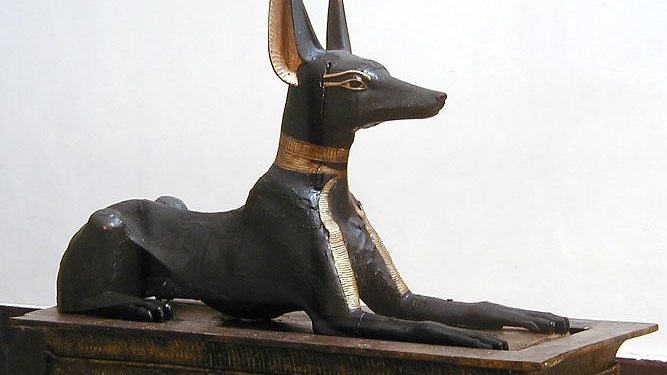
Jackals had a practical reason for ending up attached to Egyptian burial: since the Predynastic period, when the dead were buried in shallow desert graves, jackals scavenged those graves looking for a meal, and Egyptian religion answered the problem by making a jackal the guardian against the very danger jackals posed. A jackal god identified with Anubis shows up on royal tomb inscriptions from the First Dynasty, in the reigns of Hor-Aha and Djer, roughly 3150 to 2890 BC, making him one of the oldest gods in the written record.
For well over a century, the animal behind that image had a name: the Egyptian jackal, Canis aureus lupaster, treated as a regional subspecies of the golden jackal and the presumed real-world basis for Anubis's head. A 2011 study in PLOS ONE by Rueness and colleagues ran mitochondrial DNA analysis on lupaster populations across a 6,000-kilometer range spanning Egypt, Algeria, Mali, and Senegal, and found their sequences grouped not with golden jackals but with the Holarctic wolf, the Indian wolf, and the Himalayan wolf. The paper's conclusion, stated in its own title, is blunt: lupaster is not a golden jackal. The animal Egyptians had been carving into tomb walls and worshipping for four thousand years turned out, on genetic evidence, to belong to a different species than the one popular explainers still name.
Black skin on an animal that was never black
Whichever canid actually sat for the portrait, its coat was not black. Golden jackals run, according to Wikipedia's entry on the species, from pale creamy yellow in summer to dark tawny beige in winter, and the African wolf lineage identified in the 2011 study is grey rather than black as well. Anubis's black skin was never meant as a naturalistic detail. It was deliberate symbolism: black stood for regeneration and rebirth, tied to the fertile black silt the Nile flood left behind each year and to the dark discoloration embalmed flesh takes on during mummification, according to Wikipedia's summary of the god. The color describes what happens to a body in the embalming process, not what the animal on the tomb wall actually looked like. Symbolism built around fertility and rebirth gets attached to plenty of other Egyptian imagery too, which is part of why "fertility goddess" functions today as a broad, after-the-fact label rather than a title any specific ancient goddess actually carried herself.
Anubis was not even the only black jackal figure in Egyptian religion competing for the same territory. Wepwawet, a war and funerary god whose cult was centered at Asyut, was also depicted as a jackal and, on at least some accounts, in black as well. He predates the developed cult of Anubis in that region, and the two were close enough in imagery and role that historians assume they were eventually merged, or at least treated as brothers, without staying fully separate figures. A single black jackal head in an Egyptian temple relief is not automatically evidence of which god it names.
Not every jackal head on a coffin is his
The confusion runs further than Wepwawet, and it is not unusual across Egypt's crowded pantheon for two gods to end up sharing an animal form. Egyptian funerary equipment routinely features a second jackal-headed figure that has nothing to do with Anubis directly: Duamutef, one of the four sons of Horus assigned to guard the internal organs removed during mummification. Beginning in the First Intermediate Period, around 2181 to 2055 BC, Duamutef's canopic jar held the stomach, and by the late New Kingdom his jar lid took the standard jackal-head form that survives on museum shelves worldwide. He sits in the same tomb, performs a related funerary function, and wears the same animal head, and none of that makes him Anubis. The three deities, Anubis, Wepwawet, and Duamutef, were distinct enough in ancient religious bookkeeping that a temple or tomb could invoke all three by name in a single set of texts. A modern viewer looking at a wall of jackal heads has no such guarantee of telling them apart on sight.
The imiut fetish: a signature emblem he inherited
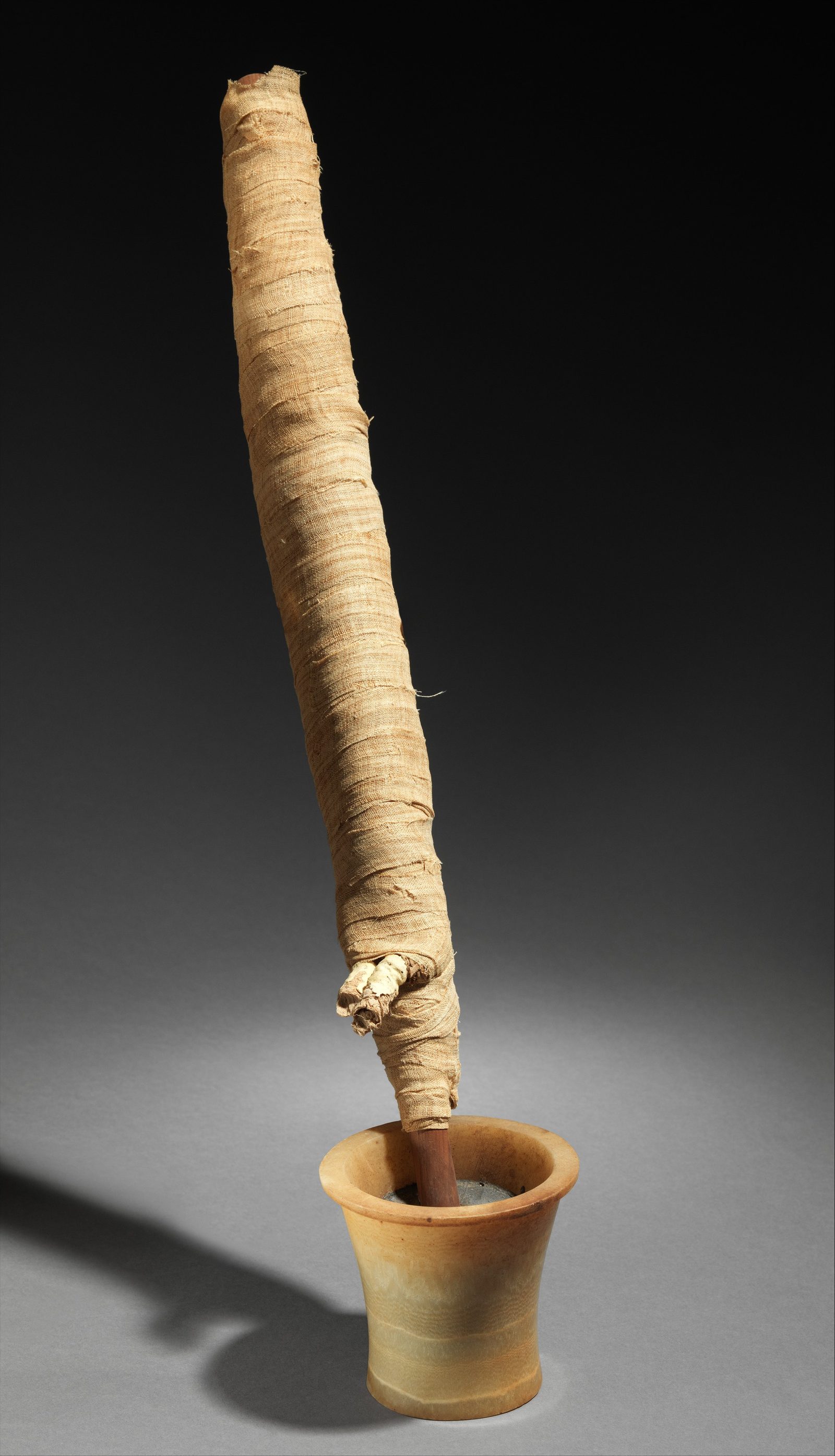
The imiut fetish comes closest to being an object that is distinctly his own, not borrowed pantheon-wide regalia: a stuffed animal skin, usually from a bull, ox, or occasionally a feline, stripped of its head and limbs and tied by the tail to a wooden pole topped with a lotus bud, the whole assembly set into a stand. Even that emblem turns out to predate him. The earliest known reference to the practice appears on a Predynastic lug handle describing a bird's entrails bound to the fetish, and the object then surfaces on royal seals from the First Dynasty reign of King Den, where it is tied to the ritual execution of prisoners, with no connection yet to Anubis or embalming at all. According to Wikipedia's entry on the imiut fetish, its original meaning represented the skin of the Apis bull, standing for rebirth and regeneration, and the object was not linked to Anubis until around the Fourth Dynasty, with modern Egyptologists coining the term "Anubis fetish" well after the fact.
The fetish went on to have a long working life once that association stuck. A Middle Kingdom example carved in travertine and cedar, dated to the reign of Amenemhat II around 1919 to 1885 BC and recovered from excavations at Lisht, is now held by the Metropolitan Museum of Art. By the Eighteenth Dynasty the object was common enough in funerary practice that Howard Carter found two versions in Tutankhamun's tomb when he opened it in 1922, both cast entirely in gold with no actual animal skin involved. Later still, during the Ptolemaic period, the same emblem started appearing in association with Osiris on temple papyri, meaning even Anubis's most personal-looking symbol spent parts of its history attached to two other gods. Sorting out which attributes genuinely belong to which god, rather than accepting the tidy modern rundown, is also basic groundwork for Kemetism, the modern revival of ancient Egyptian worship, a label that in practice covers three separately founded movements rather than one unbroken tradition.
_MET_DP330269.jpg)
The ankh and flail: shared vocabulary, not his signature
The ankh and the flail turn up in some depictions of Anubis, the ankh as the general Egyptian sign of life and the flail as a mark of authority more commonly tied to Osiris and to pharaohs themselves. Neither one was designed for him specifically. They belong to a shared visual vocabulary that ancient Egyptian art handed to whichever god or king needed to signal life or dominion in a given scene, the same way a scepter shows up across unrelated royal portraits without being any single ruler's invention. One piece of his iconography genuinely is not borrowed: the golden scale from the weighing-of-the-heart ceremony, covered in full in our main piece on Anubis, where he operates the mechanism that decides a soul's fate without ever handing down the verdict himself. Even his later Greco-Roman hybrid form, Hermanubis, keeps that pattern going: the statue tradition dresses him in a jackal head and Roman toga while handing him a caduceus, the staff that properly belongs to Hermes. Across four thousand years of Egyptian religious art, almost nothing about the way Anubis is drawn was invented purely for him, right down to the animal supplying the head.