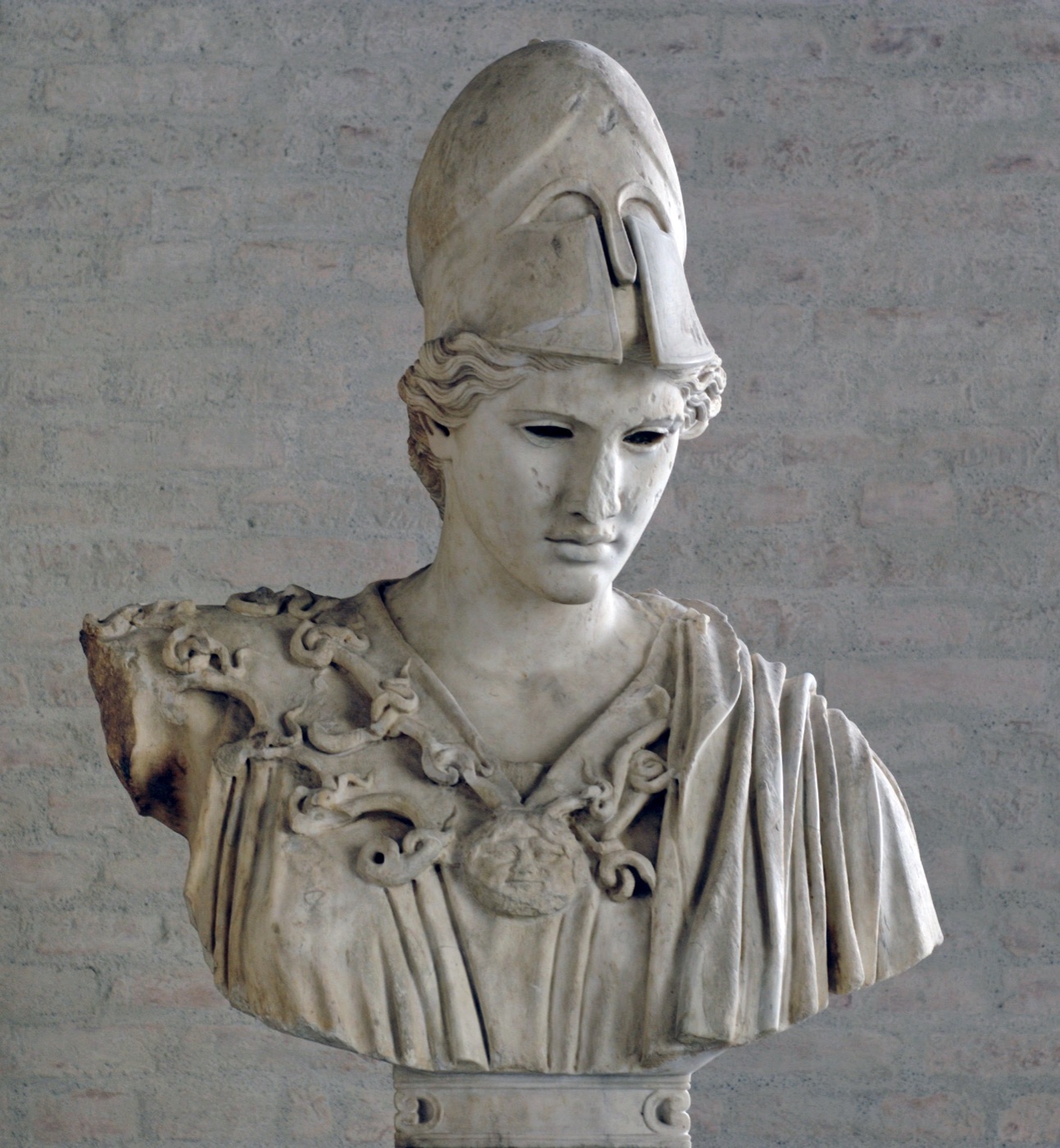

A headache fixed with an axe
Zeus's first wife was Metis, an Oceanid goddess whose name is close to the Greek word for cunning intelligence. Hesiod's Theogony calls her "wisest among gods and mortal men." That reputation turned into a problem the moment she got pregnant. A prophecy warned that Metis would first bear a daughter, then a son who would grow up to overthrow Zeus, the same way Zeus had overthrown his own father, Cronus.
Zeus's response wasn't subtle. He tricked Metis into shrinking down small (later tellings say she turned into a fly) and swallowed her whole. She kept on existing inside him afterward, still pregnant with Athena, and the pregnancy simply continued. A few versions have Metis quietly forging Athena's armor from inside Zeus the entire time, unnoticed.
Eventually Zeus was hit with a headache bad enough that nothing helped. Sources disagree about who swung the axe that split his skull open (Hephaestus gets the credit most often, though Prometheus shows up in a few tellings), but the result is consistent across versions: Athena stepped out already an adult, already armored, and reportedly already shouting a war cry. The Homeric Hymn to Athena describes the other gods freezing in shock, and says the sun god Helios stopped his chariot mid-sky to watch.
It's an odd story even by the standards of Greek mythology, but it sets up exactly who Athena is for the rest of her myths. She skips childhood entirely and shows up a finished adult, weapon already in hand.
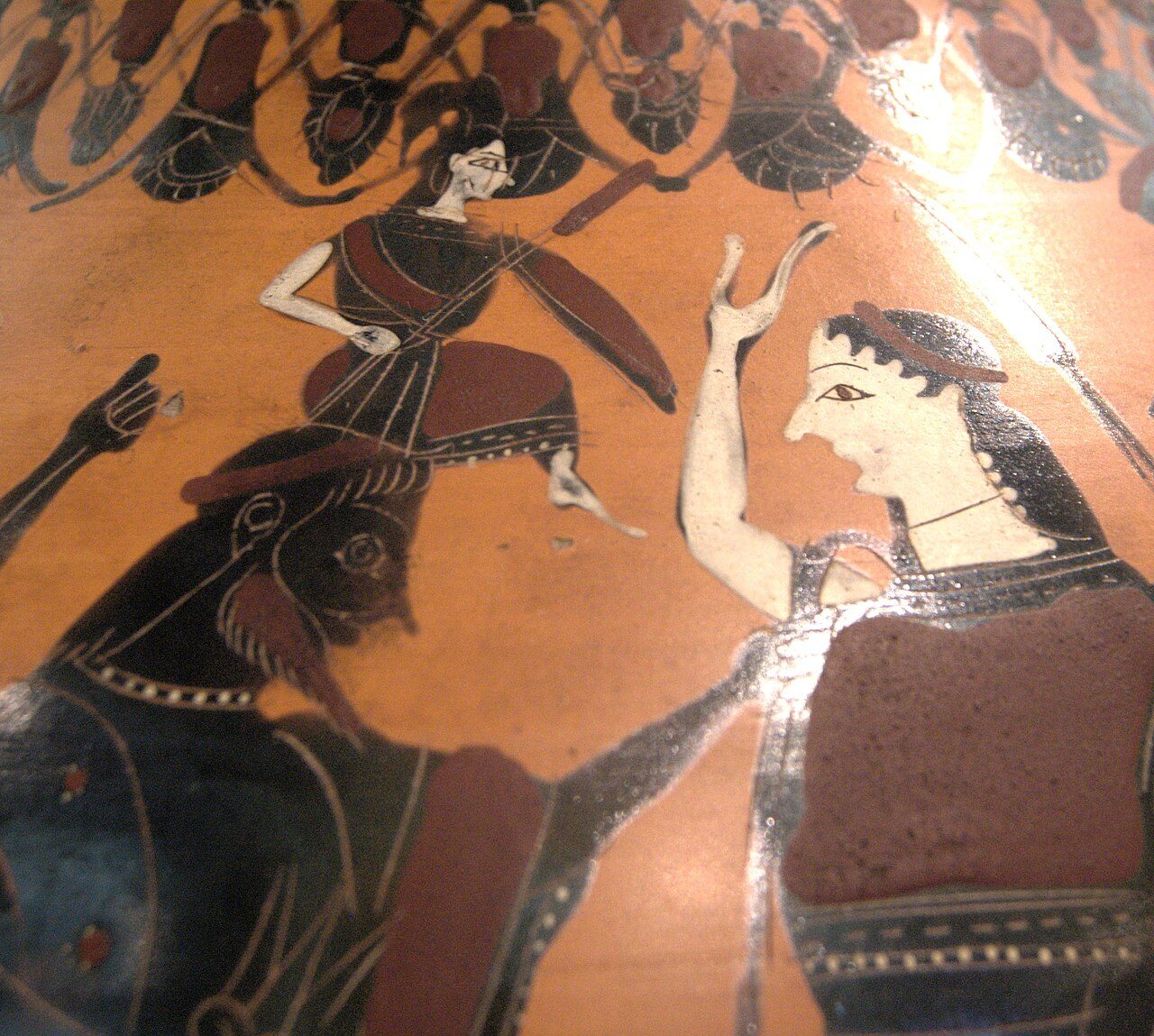

She wasn't really "the goddess of wisdom"
Calling Athena "the goddess of wisdom" isn't inaccurate, but it undersells the job. The Greeks gave her a narrower, more specific portfolio: strategic warfare, skilled craft, and protection of a city that trusted her.
The warfare half only makes sense next to her half-brother Ares. Ares got bloodlust and violence for its own sake, and the Greeks generally held him in low regard for it. Athena got tactics. She's the one planning the siege, not the one swinging blind, and myth usually has her backing the side with the better cause. Her epithet Promachos, "she who fights in front," casts her as the leader of an army, not just another soldier in the fight.
The craft side gets skipped over more often, even though it's just as central to who she was. She carried the epithet Ergane, "the industrious one," as patron of weavers, potters, and other skilled makers. The clearest story here is Arachne: a mortal weaver good enough to claim she had surpassed the goddess herself. Athena, disguised as an old woman, warned her against the boast. Arachne challenged her outright instead. In the version told by the Roman poet Ovid, Athena wove a tapestry warning mortals against exactly this kind of overreach, while Arachne wove one showing the gods, Zeus especially, mistreating mortal women. Arachne's work was, by the story's own account, flawless. Athena destroyed it anyway, struck her three times with the weaving shuttle, and when Arachne hanged herself in despair, turned her into the first spider, weaving forever. It isn't a flattering story for Athena. Greek myths rarely bother making their gods likeable. They're explaining the world, not modeling good behavior. Other goddesses get flattened by popular retelling too: Homer calls Circe a goddess, not a witch, and ends Odysseus's stay with her in a sworn oath rather than a duel.
The contest that named a city (or didn't)
The clearest Athena story, and the easiest one to picture, is her contest with Poseidon for patronage of Athens. Ancient accounts disagree about who decided it. Some make King Cecrops the judge, while Apollodorus rejects that version and has Zeus appoint the twelve gods as arbiters, with Cecrops appearing only as a witness (Library 3.14.1). The rule was the same either way: whichever god gave the better gift would win the city. Poseidon struck the rock of the Acropolis with his trident and produced a spring. When people went to drink from it, the water turned out to be salt water, striking to look at and useless to drink. Athena's gift was an olive tree. The Athenians chose it, since it meant wood, oil, and food for a city that would need all three for centuries, and the goddess was declared the winner. Poseidon's household gets far less settled treatment than his defeat here suggests: ancient sources can't even agree on where his wife Amphitrite came from, how the two married, or whether he ruled the sea before she did.
It's a tidy origin story, and it fits what Athena represented anyway: not raw power, but a gift a city could actually build a life on. Even Poseidon's domain turns out to be less singular than a trident suggests: most mythologies split water godhood across several beings, with no single figure holding it alone.
Here's where it gets genuinely disputed among scholars, in a way most retellings skip past. The obvious assumption is that the city took its name from the goddess who won it. The linguistic evidence points the other way. Athenai, the city's ancient name, is a plural place name, and that ending shows up in place names far more often than in personal names. Mycenae and Thebes both had local goddesses named the same way, Mykene and Thebe, following the place rather than the reverse. Linear B tablets from the Bronze Age call the goddess just "the Lady of Athens," a title that reads like it's attached to a place that already had a name. Even the root of Athenai itself is unclear: it likely predates Greek entirely, absorbed from whatever language the region spoke before Greek speakers arrived. Plato was already arguing about this in his dialogue Cratylus, more than two thousand years ago, and it still isn't settled.
What the owl, the aegis, and the olive actually mean
Athena's symbols weren't decoration. Each one is shorthand for a specific piece of what she represented.
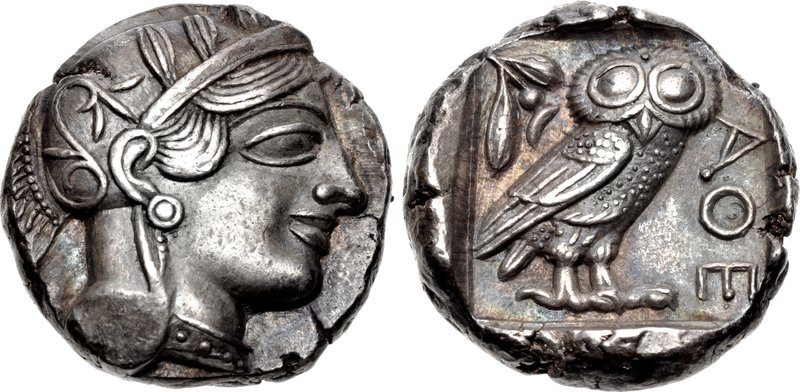
The owl started out more specific than the general wisdom symbol it later became worldwide. It's tied to her epithet glaukopis, usually translated "bright-eyed" or "gleaming-eyed." The Greek word for owl, glaux, comes from the same root, most likely because of the bird's own distinctive eyes. Athens leaned into the connection hard: silver tetradrachm coins minted from around 510 BCE carried Athena's face on one side and an owl on the other, and those coins helped finance major building projects, including the Parthenon.
The aegis was her signature piece of protective gear: a cloak or shield edged with snakes that, in most versions, has Medusa's severed head fixed to the middle of it, a trophy handed over once Perseus had done the killing. It made Athena's protection literal. Whatever she was defending, a hero or a city, stood behind something that could turn an attacker to stone just by being looked at.
The olive tree carried the logic of her contest win into everyday symbolism: prosperity earned through steady, useful work, not handed over as a windfall. Olive wreaths went to victors in Greek athletic games for the same reason.

The Athena you've probably already run into
Search "Athena" today and you'll likely land on athenahealth before you land on anything from the Bronze Age. It's a healthcare software company that partners with a network of more than 160,000 medical providers, with revenue estimated around $1.7 billion. It went public on Nasdaq in 2007, then got taken private in 2019, and since a 2022 buyout it's been owned by Bain Capital and Hellman & Friedman rather than traded on any exchange. It was incorporated in Delaware in 1997, originally under the name Athena Healthcare Incorporated, before shortening to athenahealth. It has nothing to do with Greek mythology beyond the borrowed name, but it's a genuinely odd bit of trivia: a three-thousand-year-old goddess now shares her name mainly with a medical billing platform in most search results, not with anything from the Bronze Age.
The goddess herself is inseparable from her father either way. Zeus swallowing Metis is one half of her birth story. The other half is everything Zeus represents as king of the gods: thunder, authority, the whole order of Olympus that Athena was born straight into, already armed to defend it. Read more about that side of the story in our guide to Zeus. Not all of Zeus's divine daughters got a birth story this dramatic: Eirene, his daughter by Themis, spent decades staged in Athenian comedy before the city built her an altar.