
The god buried under search results
Type just the word "Zeus" into a search engine today and you will not necessarily end up on Mount Olympus. You are as likely to land on a streaming service. The Zeus Network launched in July 2018, founded by social media personalities DeStorm Power, Amanda Cerny, and King Bach along with producer Lemuel Plummer, and it now runs an entire slate of reality shows like Baddies and Joseline's Cabaret out of Burbank, California. Somewhere in the mix there's probably a gym, a payment app, and your neighbor's dog, all fighting the same god for the same six letters.
Search "Zeus god" instead and the results clean up fast: Wikipedia, Britannica, and mythology reference sites like theoi.com dominate, with no streaming platforms in sight. That gap says something real about the word itself. The name survived three thousand years intact enough that modern companies still reach for it when they want to sound powerful, even as the actual figure behind the name gets crowded out of his own search results.
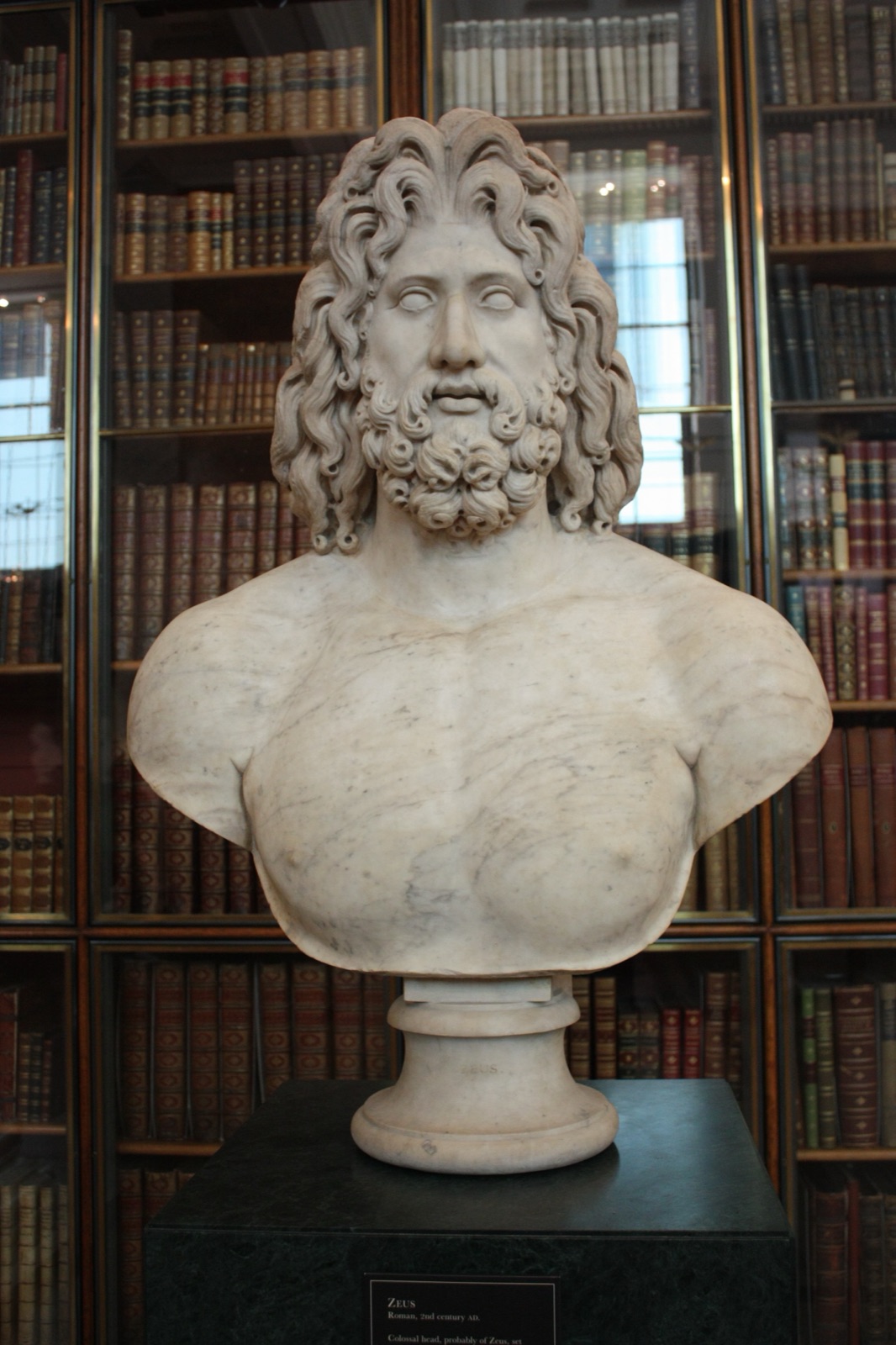
So here is the god those companies borrowed from: king of the Olympian gods, ruler of Mount Olympus, associated with the sky, thunder, law, and justice. His symbols are the thunderbolt and the eagle, and Homer and Hesiod both give him the formulaic epithet "father of gods and men." That is a title of rank rather than a family tree, and the form of address does reach past his own descendants: in the Iliad, Thetis, a sea nymph with no descent from him at all, opens her plea with "Father Zeus" (Iliad 1.503). His brother Poseidon is the pointed exception. Ordered to stand down in Iliad 15, he answers that he is "of like honour" with Zeus, and that Zeus should save his threats for "his daughters and his sons... them that himself begat."
Swallowed before he could walk
Zeus's own origin story starts with his father trying to eat him. According to Hesiod's Theogony, written around 700 BC, Cronus had heard a prophecy that one of his children would overthrow him, the same way he had overthrown his own father Uranus. His solution was blunt: swallow each child whole the moment it was born. He did this to Hestia, Demeter, Hera, Hades, and Poseidon in turn.
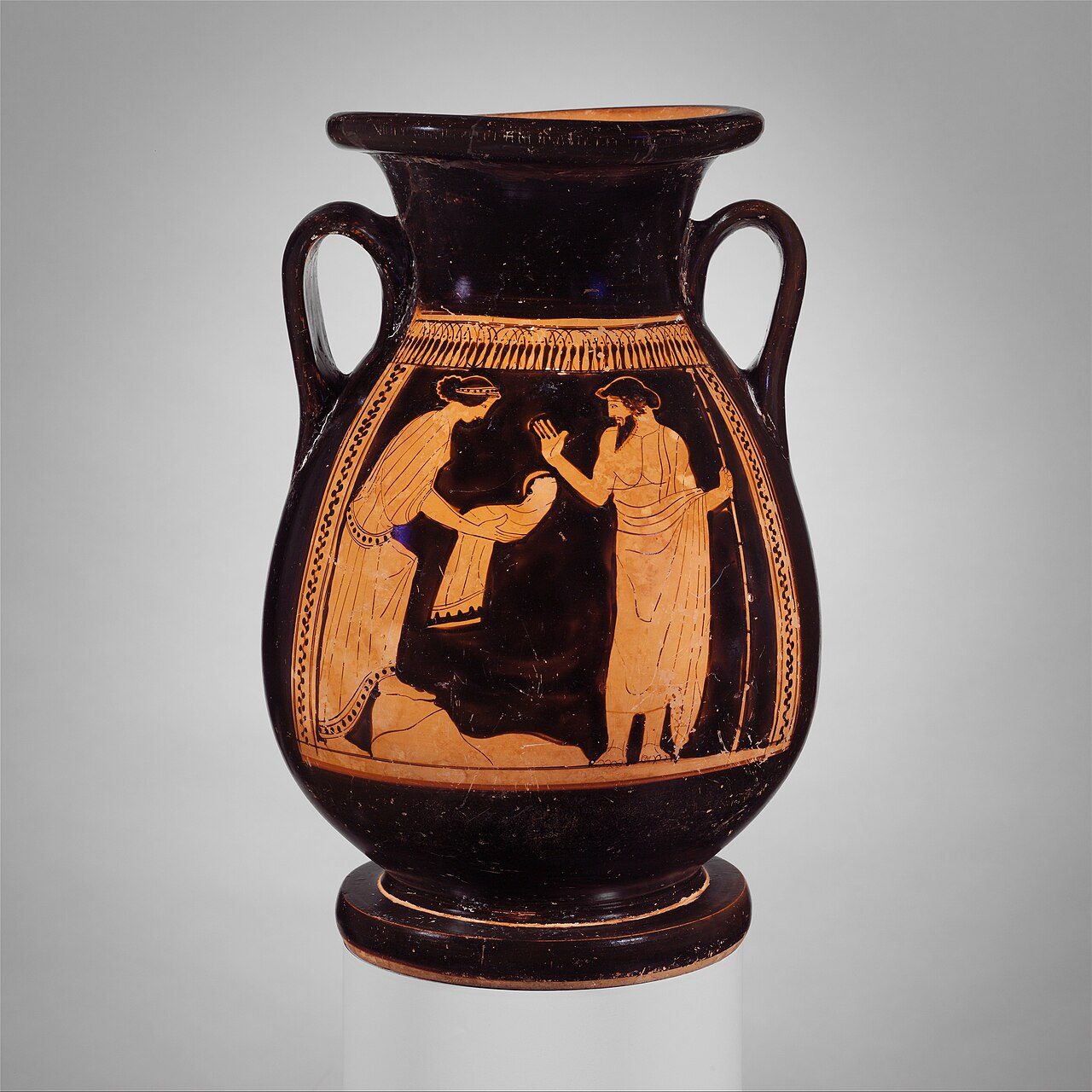
When Rhea became pregnant with Zeus, she went to her parents for a way out and traveled to Lyctus on Crete to give birth in secret. The newborn was handed off to Gaia, who raised him in a cave on Mount Aegaeon, away from Cronus entirely. Rhea then wrapped a stone in swaddling cloth and gave it to Cronus in place of the baby. He swallowed it without noticing the difference. Either he genuinely wasn't paying attention, or the Greeks telling this story just liked the image of the king of the Titans gulping down a rock.
Zeus grew up hidden, then came back for the rest of his family. He forced Cronus to bring up everything he had swallowed, siblings and stone alike, and freed the imprisoned Cyclopes, who repaid him with the thunderbolt. What followed was the Titanomachy, a ten-year war between Zeus's generation and the Titans, ending with the Titans defeated and Zeus established as ruler.

A sky-father older than Greece itself
The most common assumption about Zeus is that he stands at the top of Greek mythology because he made everything underneath him. He did not. Hesiod is explicit about the order of things, and worth quoting directly: "Verily at the first Chaos came to be, but next wide-bosomed Earth... and dim Tartarus... and Eros." All of that exists before anything resembling a personality enters the picture. Gaia produced Uranus on her own, without a partner; the twelve Titans came afterward, born to Gaia and Uranus together. Only in the third generation, born to the Titans Cronus and Rhea, do Zeus and his siblings show up at all. He inherits a universe that already exists and fights his way to the top of it. That is a very different story from a creator god, and it is worth being precise about, because the two get conflated constantly in casual retellings.
The other detail that tends to surprise people is buried in his name. Zeus traces back to the Proto-Indo-European root Dyeus, meaning something close to "sky father," and that root shows up almost unchanged across languages that split apart thousands of years before Greek mythology took its familiar shape: Dyaus Pita in the Vedic hymns of India, Iuppiter in Latin (literally built from the same root plus "father"), even Zojz in Albanian. The Online Etymology Dictionary traces the whole cluster to a root meaning "to shine", and so "sky, heaven, god", linking Greek Zeu pater directly to Sanskrit Dyaus pitar, "heavenly father". Zeus is the one Olympian whose name still shows that connection clearly. The elaborate mythology, the affairs, the thunderbolt, all of that is Greek invention layered on top. The name itself is older than Greece.
None of this makes Zeus a moral role model, and the Greeks never pretended otherwise. Modern retellings sometimes flatten him into something like a bearded superhero, wise and fair, or else play his affairs entirely for comedy. The actual myths are messier. He is jealous of his own authority and quick to punish anyone who threatens it. His relationships with mortal women usually go badly for the women, and the myths treat that as tragedy, not comedy. Ancient audiences were comfortable with gods who had power without having virtue to match it. That tension is part of the point, not an oversight.
The statue that made him one of the Seven Wonders
Zeus has one direct, physical connection to the Seven Wonders of the Ancient World, the same list that includes the Great Pyramid of Giza and the Hanging Gardens of Babylon. Around 435 BC, the sculptor Phidias built a seated statue of Zeus for the Temple of Zeus at Olympia, home of the original Olympic Games. Phidias was the same sculptor behind the Athena Parthenos in Athens, so if you're curious about his other work, it connects directly to Athena as well.
The statue was enormous. Modern estimates put the seated figure at about 12.4 meters (roughly 41 feet). No ancient writer actually gives a measurement: Pausanias, who saw it in the 2nd century AD, says the dimensions had been recorded but refuses to repeat them, on the grounds that the numbers fell far short of what it was like to stand in front of the thing. Zeus sat on a cedarwood throne decorated with ebony, ivory, gold, and precious stones. The technique was chryselephantine construction: ivory panels for the skin (face, arms, feet) and gold panels for the robe, hair, and beard, all built over a wooden frame. He held a small statue of Nike, the goddess of victory, in one hand and a scepter topped with an eagle in the other. Attendants kept the ivory coated in olive oil, and Pausanias explains the reason, which is the opposite of what most people assume: the oil protected the ivory from the marshiness of the Altis, the damp grove the sanctuary sat in. He contrasts it directly with the Athena Parthenos in Athens, where the ivory was treated with water instead, because the Acropolis was so high up it was over-dry. The Greek orator Dio Chrysostom, performing at Olympia around AD 100, said in his Olympic Discourse (Or. 12.51, linked in the sources below) that a man worn down by misfortune and grief, unable to sleep, would stand before the image and "forget all the terrors and hardships that fall to our human lot." That is a set-piece of Greek festival oratory rather than reportage, but it is also a sign the thing genuinely floored people who saw it in person.
It did not survive. The most commonly cited account has it shipped to Constantinople around the late 4th century AD and destroyed in a palace fire in 475 AD; other sources point to a fire at the temple itself decades earlier. Either way, nothing of the original remains except what archaeologists recovered from Phidias's workshop at Olympia, excavated between 1954 and 1958, which turned up ivory fragments and sculpting tools confirming the site really was where the statue had been built. There's also a smaller, stranger footnote: the Roman emperor Caligula reportedly wanted to have the statue's head removed and replaced with his own likeness. He never managed it, and Zeus's fame outlasted his by a couple thousand years.

The family tree nobody fully agrees on
Zeus fathered a large number of children across Greek myth, and the ancient sources do not always agree on the details, which is fairly normal for a mythology that developed across centuries and city-states rather than being written down once by a single author. Through Metis he had Athena, who by most accounts sprang fully grown from his head after he swallowed her mother. Through Leto he had the twins Apollo and Artemis. With his wife Hera he had Ares, Hebe, and Eileithyia. Mortal women he pursued, often in disguise as an animal or a shower of gold, produced Heracles, Perseus, Helen of Troy, and Dionysus, among many others. The pattern across almost all of these stories is the same: Zeus wants something, takes a form that lets him get it, and the consequences land mostly on the mortal or lesser figures involved rather than on him. The mortal side of those stories is usually a footnote; the ancient sources could not even agree on how Alcmene, Heracles's mother, died.
That imbalance is worth sitting with rather than smoothing over, because it is part of what makes Zeus a different kind of central figure than, say, a monotheistic creator god. He's powerful and permanent, and nobody in the stories makes him answer for what he does with that power. These are not really moral lessons about him. They read more like stories about power and its consequences, told by people who put their strongest god at the center and then let him be exactly as flawed as power tends to make anyone. The rest of MythCairn's Mythology pillar covers gods like Poseidon and Anubis.