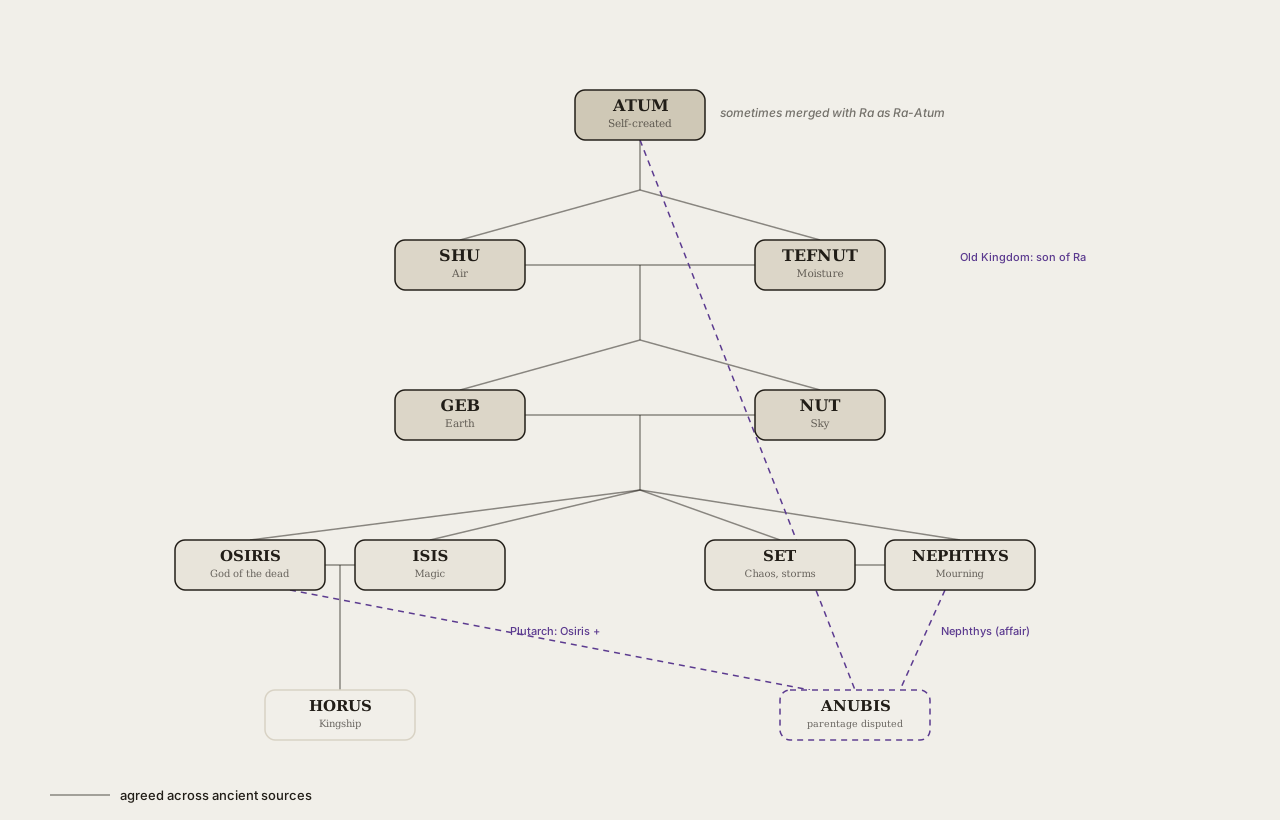
A nine-god chart that reads like it was always this settled
Heliopolis's priesthood organized its creation theology into a precise chain of nine gods, and the Pyramid Texts of the Old Kingdom already treat it as an established sequence: the sun god Atum created himself out of the primeval waters, then produced Shu, god of air, and Tefnut, goddess of moisture, without any partner. Shu and Tefnut in turn produced Geb, the earth, and Nut, the sky, and Geb and Nut produced the last four: Osiris, Isis, Set, and Nephthys. Nine names, four generations, no gaps. It's the kind of genealogy that looks like it could only ever have been drawn one way.
That impression doesn't survive contact with what happens at the edges of the chart. The Ennead itself was only ever one of three rival Egyptian creation theologies running at the same time, Hermopolis and Memphis each taught their own, and none of the three was ever formally declared correct over the others. And even within Heliopolis's own version, the god most people now assume belongs in this family, Anubis, was folded in centuries after the Ennead's core nine were already fixed, through a rewrite of his own origin that ancient Egyptian sources never fully agreed on.
One self-created god, four generations, no disputes
The chain from Atum down to the Ennead's youngest four is, unusually for Egyptian mythology, not seriously contested in the surviving record. Atum was sometimes merged with the older sun god Ra as the composite Ra-Atum, but his role as the line's starting point holds across sources. Shu and Tefnut, Geb and Nut, and finally Osiris, Isis, Set, and Nephthys follow in the same order in the Pyramid Texts as in every later retelling. Of the four youngest, Osiris and Isis became the myth's central couple, parents to Horus, whose claim to Egypt's throne drives the succession conflict with Set that runs through most of what survives of the wider Osiris myth; Set and Nephthys were paired the same way, siblings married to each other in the same generation.
That's the whole agreed-upon backbone: one self-created god at the top, four unremarkable generational splits, and a clean stop at nine names. Nothing about it required later editing, because nothing about it was ever seriously in dispute.
Anubis: four different answers to "whose son is he"
Anubis's parentage is a different story entirely, and it shifts depending on which century of Egyptian religion is doing the answering. In Old Kingdom sources, he is simply a son of Ra, the sun god, full stop, no mother named. By the Coffin Texts of the First Intermediate Period, that single answer had already splintered into three competing ones: Anubis as the child of the cow goddess Hesat, or alternately of Bastet, or of Ra and Nephthys together. Only by the Middle and New Kingdoms does the version most people now assume was always standard finally appear: Anubis as the son of Osiris and Isis outright, folded neatly into the same family whose funerary rites he oversees.
The Greek writer Plutarch, in his essay De Iside et Osiride, written around the turn of the second century AD, gives a fourth version that has nothing to do with tidy family charts. In Frank Cole Babbitt's translation, Plutarch says Isis learned that Osiris had slept with her sister Nephthys "through ignorance, in the belief that she was Isis," proof being a garland of melilote flowers he had left behind. Nephthys, afraid of her husband Set, abandoned the resulting child at birth; Isis found him "with the help of dogs which led Isis to it" and raised him herself as a protector figure in the household, naming him Anubis. On this reading, the goddess most people assume is his mother is actually the aunt who took him in after his biological mother abandoned him.
Why Egyptian religion never forced a single answer
None of these four versions of Anubis's parentage ever displaced the others outright, and that wasn't an oversight. Egyptologist Erik Hornung, in Conceptions of God in Ancient Egypt: The One and the Many, describes Egyptian religion's standard tool for handling exactly this kind of overlap as syncretism, merging or layering rival claims rather than eliminating any of them, the same mechanism that let Heliopolis's sun god Ra and Thebes's Amun coexist as the fused Amun-Ra instead of one god simply replacing the other. A genealogy chart assumes there's a single correct edge connecting each name to its parent. Egyptian religious practice, across three thousand years and multiple regional priesthoods with their own local traditions to protect, mostly didn't operate on that assumption at all.
It's a different pattern than the one that produces disputed parentage in Greek mythology's own family tree, where Hesiod and Homer simply wrote two different, competing accounts of Aphrodite's and Hephaestus's origins that later readers had to choose between. Anubis's four versions aren't two authors disagreeing about one fixed past; they're four different working answers, produced centuries apart by priesthoods with different institutional reasons for wanting him to belong to a particular family, none of which the ancient Egyptian record ever tried to settle for good.