
Two ancient answers to one question
There is no single answer, because the two best-known ancient tellings disagree about what Prometheus did wrong. In Hesiod, the poet who wrote around 700 BC, Zeus is angry because Prometheus tried to trick him. In Aeschylus's play Prometheus Bound, Zeus is a new ruler punishing a Titan who sided with humans. Fire matters in both, but it is the whole offense in only one of them.
Britannica's summary follows Hesiod: Zeus was tricked into accepting bones and fat instead of meat, hid fire from mortals, and Prometheus stole it back. That gets the order right.
Hesiod's version: a rigged sacrifice at Mecone
In the Theogony, gods and mortals are settling how sacrifices will be shared at a place called Mecone. Prometheus cuts up a great ox and sets out two portions. For humans he wraps the meat and innards in the ox's stomach. For Zeus he arranges the white bones and covers them with shining fat.
Zeus is not fooled. Hesiod says he "saw and failed not to perceive the trick", but he takes the fat-covered bones anyway, and the poem gives this as the reason people burn bones for the gods on their altars. His first words to Prometheus are a complaint about the split: "how unfairly you have divided the portions!" Prometheus answers with a soft smile and tells Zeus to pick whichever he likes.
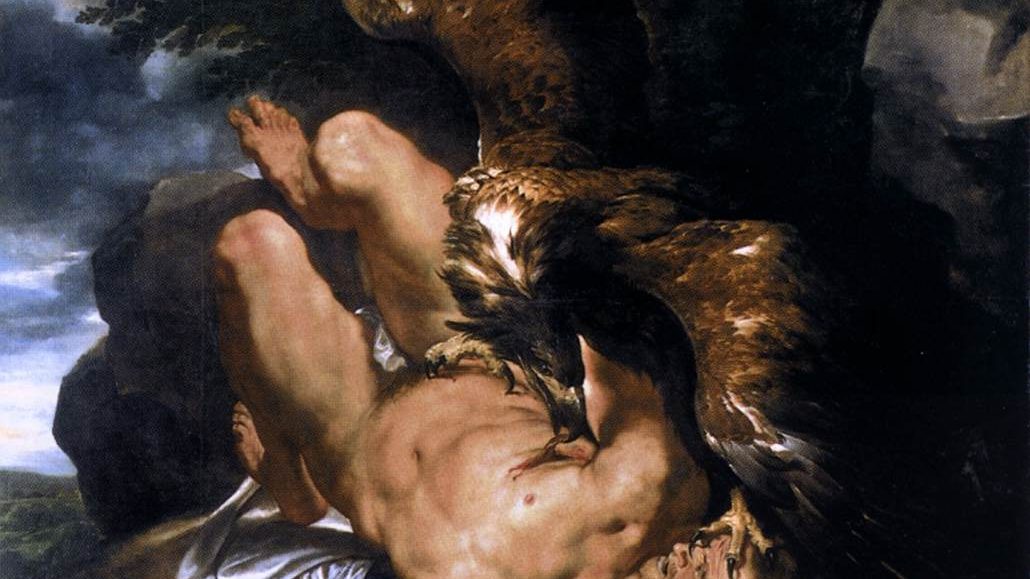
The Theogony gives the punishment in a few lines that come before this story. Zeus binds Prometheus with chains, drives a shaft through his middle and sets a long-winged eagle on him to eat his immortal liver, which grows back each night. Hesiod's stated reason, when he describes Zeus later calming down, is that Prometheus "matched himself in wit with the almighty son of Cronos". The crime in that poem is the contest of wits, and the fire is one round of it.
Where the fire fits in Hesiod
Both Hesiod poems connect the trick to the fire. Zeus stayed mindful of the trick afterward and kept fire from humans. In Works and Days the reason is stated directly: "Zeus in the anger of his heart hid it, because Prometheus the crafty deceived him." Prometheus stole it back in a hollow fennel stalk.
Notice who pays for the theft. Zeus tells Prometheus, "I will give men as the price for fire an evil thing." That evil is Pandora, shaped from clay by Hephaestus and dressed by Athena. The Works and Days passage on Pandora runs through the jar of troubles without a word about chains or an eagle. In the Theogony the chains and Pandora are separate blows. In Works and Days Zeus calls the woman a plague to Prometheus himself as well as to men.
Works and Days adds a detail that is easy to miss. Prometheus had told his brother Epimetheus never to accept a gift from Olympian Zeus and to send it back. Epimetheus took Pandora anyway and understood only afterward what he had accepted.
Aeschylus's version: a god who saved humanity
Prometheus Bound gives a different reason, and it comes from Prometheus himself. After Zeus took his father's throne and handed out privileges to the gods, he ignored mortals, "desiring to bring the whole race to an end and create a new one in its place." Prometheus says he alone dared to oppose this. In the play he also claims to have helped Zeus win against the Titans, since his counsel is why Cronus and his allies lie in Tartarus.
The gifts he lists are not only fire. He tells the chorus, "I caused blind hopes to dwell within their breasts," which he says stopped mortals from foreseeing their doom, and then adds, "In addition, I gave them fire." From fire, he says, they will learn many arts. Here Zeus is a tyrant and Prometheus a benefactor, which is close to the reverse of the trickster in Hesiod.
One caution about this source. The play is traditionally credited to Aeschylus, but since the late 1970s scholars including Oliver Taplin and Mark Griffith have argued it may not be his, and there is no consensus. The play is also probably the first of a linked set, and the later plays survive only in fragments, so how Aeschylus meant the quarrel to end is not known.
Reading the two side by side
The two tellings judge Zeus differently. Hesiod ends the Prometheus story with a moral aimed at the listener: "it is not possible to deceive or go beyond the will of Zeus," since even kindly Prometheus, for all his cleverness, could not escape his anger. Zeus wins every round, and the reader is expected to accept that.
In Prometheus Bound the moral runs the other way. The chained Titan says it is "a disease that is somehow inherent in tyranny to have no faith in friends," and the play lets him make the case against Zeus while Zeus never appears on stage. Prometheus's account is only one voice in the play, though. In the opening lines Power (Kratos in Greek), one of Zeus's enforcers, states the offense differently: Prometheus "purloined and bestowed upon mortal creatures" the fire, and is bound "so that he may learn to bear with the sovereignty of Zeus and cease his man-loving ways." So the play carries two accounts, one from the prisoner and one from the jailer, and the prisoner has every motive to call his act kindness.
What neither Hesiod poem says
Two things people assume about this story are missing from Hesiod. He does not say Prometheus made humans. Men already exist in both poems, and the Theogony's Epimetheus is only said to be the first to take a woman from Zeus. The idea that Prometheus shaped people from clay shows up in later writers, and Wikipedia's survey of the myth names Sappho, Aesop and Ovid. A Latin fable preserved through the Phaedrus appendix even has him sculpt a statue of Truth, as described in the Aletheia article.
Hesiod also names no mountain. Britannica's summary credits Hesiod with the Caucasus, but the Theogony passage names no mountain and only says he was bound. The scene of Prometheus fixed to a Scythian crag belongs to Prometheus Bound.
Hesiod does end the story, and he ends it with Zeus's consent. Heracles, Zeus's own son by the mortal Alcmene, kills the eagle and frees Prometheus, and Zeus allows it so that the glory of Heracles, born in Thebes, would grow even greater. Hesiod says Zeus was still angry but stopped his wrath. Prometheus, a cousin of Zeus (see the Greek gods family tree), ends up freed by Zeus's own son with his father's blessing.